OnePlus’ hype train has finally reached its destination, and the company has unveiled its latest flagships — the OnePlus 9, the OnePlus 9 Pro, and the OnePlus 9R. The phones feature an all-new design, top-of-the-line performance chops, and a new camera system developed in collaboration with Hasselblad. On top of that, the OnePlus 9 series offers several additional features that make them a significant upgrade over the OnePlus 8 lineup. In case you’re planning on getting a OnePlus 9 series phone for yourself, here’s everything you need to know to make an informed decision:
Navigate this page:
OnePlus 9 series: Variants
As seen in various leaks over the last few months, the new OnePlus 9 series includes three devices — the OnePlus 9, the OnePlus 9 Pro, and the OnePlus 9R. While the OnePlus 9 and OnePlus 9 Pro are global devices that will be available in all regions where OnePlus has a presence, the OnePlus 9R is limited to the Indian market.
OnePlus 9 series: Specifications
| Specification |
OnePlus 9 |
OnePlus 9 Pro |
OnePlus 9R |
| Build |
- Fiberglass-reinforced polymer frame
- Gorilla Glass 5 front and back
|
- Aluminum frame
- Gorilla Glass 5 front and back
|
- Metal frame
- Glass back
- Gorilla Glass front
|
| Dimensions & Weight |
- North America/Europe:
- India/China:
|
- 163.2 x 73.6 x 8.7mm
- 197g
|
|
| Display |
- 6.55-inch FHD+ AMOLED (2400 x 1080p)
- 402PPI
- 20:9 aspect ratio
- 120Hz refresh rate
- 1100nits peak brightness
- Supports sRGB and DCI-P3 color space
- HDR10+
- Automatic color temperature adjustment
- Gorilla Glass 5
|
- 6.7-inch QHD+ LTPO AMOLED (3216 x 1440p)
- 525PPI
- 20.1:9 aspect ratio
- Smart 120Hz refresh rate (Adaptive 1-120Hz)
- 360Hz touch polling rate
- 1300nits peak brightness
- 10-bit color depth
- Supports sRGB and DCI-P3 color space
- HDR10+
- MEMC
- Automatic color temperature adjustment
- Gorilla Glass 5
|
- 6.55-inch FHD+ AMOLED (2400 x 1080)
- 402PPI
- 20:9 aspect ratio
- 120Hz refresh rate
- sRGB and DCI-P3 support
|
| SoC |
- Qualcomm Snapdragon 888
- 1x Kryo 680 (ARM Cortex X1-based) Prime core @ 2.84GHz
- 3x Kryo 680 (ARM Cortex A78-based) Performance cores @ 2.4GHz
- 4x Kryo 680 (ARM Cortex A55-based) Efficiency cores @ 1.8GHz
- Adreno 660 GPU
|
- Qualcomm Snapdragon 888
- 1x Kryo 680 (ARM Cortex X1-based) Prime core @ 2.84GHz
- 3x Kryo 680 (ARM Cortex A78-based) Performance cores @ 2.4GHz
- 4x Kryo 680 (ARM Cortex A55-based) Efficiency cores @ 1.8GHz
- Adreno 660 GPU
|
- Qualcomm Snapdragon 870
- 1x Kryo 585 Prime core @ 3.2GHz
- 3x Kryo 585 Performance cores @ 2.4GHz
- 4x Kryo 385 Efficiency cores @ 1.8GHz
- Adreno 650
|
| RAM & Storage |
- 8GB LPDDR5 RAM + 128GB UFS 3.1 storage
- 12GB + 256GB
|
- 8GB LPDDR5 RAM + 128GB UFS 3.1 storage
- 12GB + 256GB
|
- 8GB + 128GB UFS 3.1
- 12GB + 256GB
|
| Battery & Charging |
- 4,500mAh battery
- 65W wired fast charging (1-100% in 29 minutes)
- 45W wired fast charging (USB PD)
- 15W Qi wireless charging (North America/Europe only)
- Warp Charge 65T charger included (supports up to 45W USB PD or PPS for non-OnePlus devices)
|
- 4,500mAh battery
- 65W wired fast charging (1-100% in 29 minutes)
- 45W wired fast charging (USB PD)
- 50W wireless fast charging (1-100% in 43 minutes)
- Warp Charge 65T charger included (supports up to 45W USB PD or PPS for non-OnePlus devices)
|
- 4,500mAh
- 65W wired fast charging support
- Warp Charge 65 charger included in the box
|
| Security |
In-display fingerprint scanner |
In-display fingerprint scanner |
In-display fingerprint scanner |
| Rear Camera(s) |
- Primary: 48MP Sony IMX689, f/1.8, EIS, PDAF+CAF
- Secondary: 50MP Sony IMX766 ultra-wide, f/2.2, freeform lens
- Tertiary: 2MP monochrome sensor
- Dual LED flash
- Video:
- 8K video @ 30fps
- 4K video @ 30/60fps
- Slow motion: 720p @480fps, 1080p @ 240fps
- Time-lapse: 1080p @ 30fps, 4K @ 30fps
- Additional features: Nightscape, Super Macro, UltraShot HDR, Smart Scene Recognition, Portrait mode, Pro mode, Panorama, Tilt-shift mode, Focus Peaking, Cat/Dog Face focus, RAW support, Filters, Super Stable video, Video Nightscape, Video HDR, Video Portrait, Focus Tracking, Hyperlapse
|
- Primary: 48MP Sony IMX 789, f/1.8, OIS, EIS, PDAF+CAF
- Secondary: 50MP Sony IMX766 ultra-wide, f/2.2, freeform lens
- Tertiary: 8MP 3.3x telephoto, f/2.4, OIS
- Quaternary: 2MP monochrome sensor
- Dual LED flash
- Video:
- 8K video @30fps
- 4K video @ 30/60/120fps
- Slow motion: 720p @ 480fps, 1080p @ 240fps
- Time-lapse: 1080p @ 30fps, 4K @ 30fps
- Additional features: Nightscape, Super Macro, UltraShot HDR, Smart Scene Recognition, Portrait mode, Pro mode, Panorama, Tilt-shift mode, Focus Peaking, Cat/Dog Face focus, RAW support, Filters, Super Stable video, Video Nightscape, Video HDR, Video Portrait, Focus Tracking, Hyperlapse
|
- Primary: 48MP f/1.7 Sony IMX586, PDAF+CAF
- Secondary: 16MP f/2.2 Sony IMX481 wide-angle, 123° FoV
- Tertiary: 5MP macro
- Quaternary: 2MP monochrome
|
| Front Camera(s) |
16MP Sony IMX471, f/2.4, FF, EIS |
16MP Sony IMX471, f/2.4, FF, EIS |
16MP Sony IMX471, f/2.4, FF, EIS |
| Port(s) |
USB 3.1 Gen1 Type-C |
USB 3.1 Gen1 Type-C |
USB 3.1 Gen1 Type-C |
| Audio |
- Dual stereo speakers
- Noise cancellation support
- Dolby Atmos certified
|
- Dual stereo speakers
- Noise cancellation support
- Dolby Atmos certified
|
- Dual stereo speakers
- Noise cancellation support
- Dolby Atmos certified
|
| Connectivity |
- LTE 4×4 MIMO
- SA/NSA 5G
- Wi-Fi 6 2×2 MIMO (dual-band)
- Bluetooth 5.2 (aptX, aptX HD, LDAC, AAC support)
- NFC
- GPS (L1+L5 Dual Band), GLONASS, Galileo, Beidou, A-GPS
|
- LTE 4×4 MIMO
- SA/NSA 5G
- Wi-Fi 6 2×2 MIMO (dual-band)
- Bluetooth 5.2 (aptX, aptX HD, LDAC, AAC support)
- NFC
- GPS (L1+L5 Dual Band), GLONASS, Galileo, Beidou, A-GPS
|
- LTE 4×4 MIMO
- SA/NSA 5G
- Wi-Fi 6 2×2 MIMO (dual-band)
- Bluetooth 5.1
- GPS (L1+L5 Dual Band), GLONASS, Galileo, Beidou, A-GPS
|
| Software |
OxygenOS 11 based on Android 11 |
OxygenOS 11 based on Android 11 |
OxygenOS 11 based on Android 11 |
| Other Features |
- IP68 dust and water resistance (T-Mobile version only)
- Alert slider
- Upgraded haptic motor
- OnePlus Cool Play cooling system (five-layer system with a vapor chamber and layers of graphite and copper)
|
- IP68 dust and water resistance
- Alert slider
- Upgraded haptic motor
- OnePlus Cool Play cooling system (multi-layer system with a vapor chamber and layers of graphite and copper)
|
|
| Colors |
Winter Mist, Arctic Sky, Astral Black |
Morning Mist, Forest Green, Stellar Black |
Lake Blue, Carbon Black |
OnePlus 9 XDA Forums || OnePlus 9 Pro XDA Forums
Design
The OnePlus 9 series follows the same Burdenless Design philosophy as a couple of older OnePlus devices but with a few refinements. The devices look pretty much the same as the OnePlus 8 series, except for the new camera module and the back panel finishes. Both phones have a curved back that merges seamlessly with the slim frame, but the OnePlus 9 features a flat display while the OnePlus 9 Pro packs a curved one. The devices also differ in terms of material choice, with the vanilla OnePlus 9 featuring a fiberglass-reinforced frame (with a glossy metallic finish) and the Pro variant packing an aluminum frame.

As mentioned earlier, the OnePlus 9 and 9 Pro sport a new camera island design. Unlike the OnePlus 8 series devices, the latest OnePlus flagships feature rectangular camera islands in the top left corner of the back panel. On the OnePlus 9, the camera module houses a triple camera setup with a dual-LED flash and Hasselblad branding. On the other hand, the Pro variant packs a quad-camera setup with a dual-LED flash and Hasselblad branding.

Arctic Sky, Stellar Black, and Winter Mist OnePlus 9
Both phones also get new back panel finishes. The OnePlus 9 comes in three colorways inspired by nature — Winter Mist, Arctic Sky, and Astral Black. The Winter Mist variant has a gradient refraction effect that lights up the device in different shades of purple, the Arctic Sky variant has a cool blue finish with a matte glass, and the Astral Black finish has a glossy glass on top of a matte black film that offers a minimal look.

Morning Mist, Astral Black, and Pine Green OnePlus 9 Pro
The OnePlus 9 Pro also comes in three nature-inspired color options — Morning Mist, Pine Green, and Stellar Black. The Morning Mist finish, which we saw in various leaks over the last few months, shimmers from silver to black, the Pine Green variant offers a double-layer matte finish that gives the device a softer feel, and the Stellar Black variant has a frosted matte glass that resembles the classic OnePlus Sandstone finish.

Carbon Black and Lake Blue OnePlus 9R
The affordable OnePlus 9R features a flat display with a hole-punch cutout in the top left corner, a curved glass back, and the same camera island design as the other two models. However, it doesn’t feature Hasselblad branding. It comes in two color variants — Lake Blue and Carbon Black — and both variants have a matte finish. Surprisingly, the OnePlus 9R has a metal frame, while the more premium OnePlus 9 doesn’t.
As far as the ports and buttons are concerned, the OnePlus 9 features a USB Type-C port at the bottom, the power button and alert slider on the right edge, and the volume rocker on the left edge. Similarly, the OnePlus 9 Pro packs a USB Type-C port at the bottom, the power button and alert slider on the right edge, and the volume rocker on the left edge. However, the frame on the Pro variant is a bit slimmer (2.2mm) than the one on the non-Pro variant, which gives it a more premium feel in hand. The OnePlus 9R also features the same button and port layout as the other two devices.
For durability, OnePlus is offering Gorilla Glass 5 on the front and back on both devices and an IP68 rating for dust and water resistance. Do note that the IP68 rating is only available on the T-Mobile version of the OnePlus 9, but it’s available on all variants of the OnePlus 9 Pro. Sadly, the affordable OnePlus 9R doesn’t come with an IP certification.
Display
OnePlus 9
The OnePlus 9 packs a 6.55-inch flat AMOLED display with a resolution of 2400 x 1080 pixels. It’s a 20:9 panel that offers a pixel density of 402 pixels per inch (PPI). The display has a single hole-punch cut-out for the selfie camera in the top-left corner, minimal bezels on three sides, and a slight chin.

The display offers a peak refresh rate of 120Hz, 1100nits of peak brightness with 8192 levels of adjustment, and HDR10+ certification. OnePlus claims that the display supports both sRGB and DCI-P3 color space, and it offers color accuracy that exceeds leading professional monitors. The display also comes with HDR10+ certification.
OnePlus 9 Pro
While the OnePlus 9’s display is pretty much the same as the one on the OnePlus 8T, the OnePlus 9 Pro’s display boasts of a couple of additional features. The curved panel measures 6.7-inches and offers a resolution of 3216 x 1440 pixels. It has a 20.1:9 aspect ratio and offers a pixel density of 525PPI. Much like the OnePlus 9, the display on the Pro-variant features a single hole-punch cut-out for the selfie camera. But its side bezels are much slimmer as the display curves over the edges. The top and bottom bezels are also comparatively slimmer.

The display offers a peak refresh rate of 120Hz, but unlike the vanilla model, it’s an LTPO panel that brings adaptive refresh rate support to the device. Thanks to this, the device can automatically adapt the refresh rate from 1-120Hz based on the content being viewed. OnePlus claims that this feature helps reduce the power consumption by 50% compared to the vanilla model.
The panel also supports a 360Hz touch polling rate for faster touch response, 1300nits of peak brightness, native 10-bit color depth, and HDR10+ certification. Furthermore, the device comes with a few premium display features like MEMC, automatic color temperature adjustment, front/back ambient light sensing for automatic brightness adjustments, and more. As with the OnePlus 9, OnePlus claims that the display supports both sRGB and DCI-P3 color space, and it offers color accuracy that exceeds leading professional monitors.
OnePlus 9R
Despite its affordable price, the OnePlus 9R also packs a FHD+ AMOLED display that refreshes at 120Hz. While it doesn’t offer adaptive refresh rate support or a high touch polling rate, it’s still a great panel for an affordable flagship.

The display has a resolution of 2400 x 1080 pixels, which results in a pixel density of 402 pixels per inch. It has a 20:9 aspect ratio, and it also offers support for the sRGB and DCI-P3 color space.
SoC, RAM, & Storage
As expected, both the OnePlus 9 series devices are powered by Qualcomm’s flagship Snapdragon 888 SoC. The octa-core SoC packs one Kryo 680 prime core (ARM Cortex X1-based) clocked at 2.84GHz, three Kryo 680 performance cores (ARM Cortex A78-based) clocked at 2.4GHz, and four Kryo 680 efficiency cores (ARM Cortex A55-based) clocked at 1.8GHz.
The SoC packs an Adreno 660 GPU, Qualcomm’s new Spectra 580 ISP, and the Snapdragon X60 integrated 5G modem. The SoC on both phones is paired with either 8GB or 12GB of LPDDR5 RAM and either 128GB or 256GB of fast UFS 3.1 storage. Unfortunately, the devices don’t feature a microSD card slot for further expansion.
As we expected, the OnePlus 9R packs Qualcomm’s new Snapdragon 870 chip. It’s a minor upgrade over the company’s flagship Snapdragon 865 chip from last year, featuring a slightly higher clocked prime core. The octa-core SoC packs on Kryo 585 prime core clocked at 3.2Ghz, three Kryo 585 performance cores clocked at 2.4Ghz, and four Kryo 385 efficiency cores clocked at 1.8GHz. It also features the Adreno 650 GPU and the Snapdragon X55 modem.
Much like the other devices in the lineup, the Snapdragon 870 on the OnePlus 9R is paired with either 8GB or 12GB of RAM and either 128GB or 256GB of UFS 3.1 storage. The phone doesn’t feature a microSD card for further expansion.
Cameras
The OnePlus 9 and the OnePlus 9 Pro come with a couple of noteworthy improvements on the camera front. The devices pack impressive new camera hardware, a new Natural Color Calibration profile developed in collaboration with Hasselblad, a flagship-level ultra-wide camera, and many more software features.

OnePlus 9
The OnePlus 9 features a triple-camera setup on the back and a single front-facing shooter. The main camera on the phone uses a 48MP Sony IMX689 sensor. It has an f/1.8 aperture, features electronic image stabilization, and offers multi autofocus support (All Pixel Omni-Directional PDAF+CAF). It also offers 12-bit RAW support and dual native ISO.

The primary camera is paired with a 50MP Sony IMX766 wide-angle camera that features a Freeform Lens to reduce edge distortion. It has an f/2.2 aperture, and it can even act as a high-res macro camera capable of focusing from as close as 4cm from the subject. The camera island on the back also houses a 2MP monochrome camera that works with the main 48MP shooter to add detail to monochrome photos. Over on the front, the phone packs a 16MP f/2.4 Sony IMX471 sensor with electronic image stabilization.
If you’re interested in learning more about the OnePlus 9’s camera chops, check out Mario’s detailed camera review (linked below).
OnePlus 9 Camera Review: The most refreshing OnePlus camera I’ve ever used
OnePlus 9 Pro
While the OnePlus 9 Pro also features a 48MP main camera, it uses a Sony IMX789 sensor instead of the IMX689 sensor. The main camera has an f/1.8 aperture, features both electronic and optical image stabilization, and offers the same autofocus system as on the non-Pro variant. It also offers 12-bit RAW support, dual native ISO, and DOL-HDR.

The phone features the same 50MP Sony IMX766 wide-angle camera with a freeform lens and the same 2MP monochrome sensor. However, it includes an additional telephoto camera on the back. This camera has an f/2.4 aperture and optical image stabilization. It offers 3.3x optical zoom and 30x digital zoom.
OnePlus 9R
The OnePlus 9R takes a major hit in the camera department. While it does offer a quad-camera setup, it isn’t nearly as good as the one found on the other two models. The phone features a 48MP f/1.7 Sony IMX586 primary camera with PDAF and CAF, a 16MP f/2.2 Sony IMX481 wide-angle camera with a 123° FoV, a 5MP macro camera, and a 2MP monochrome camera.

While the rear-facing camera setup isn’t that impressive, the OnePlus 9R features the same front-facing shooter as the other two models. It’s a 16MP f/2.4 Sony IMX471 sensor that offers electronic image stabilization.
Camera features
The OnePlus 9 series comes with a lot of new software tweaks and modes to improve the camera performance and give you more control. We’ve already mentioned the new Natural Color Calibration profile developed in collaboration with Hasselblad, which offers more accurate color reproduction on photos taken with the OnePlus 9 and the OnePlus 9 Pro. The new Hasselblad Pro Mode is another outcome of the collaboration, which comes with a new UI based on Hasselblad’s image processing software. The mode gives users more control over the camera settings, including ISO, focus, exposure, and white balance adjustments.

Hasselblad Pro Mode
Additionally, the OnePlus 9 phones come with a new tilt-shift mode that simulates the effect of a tilt-shift lens, 8K 30fps video support, 4K 120fps video support (OnePlus 9 Pro only), Focus Peaking, Focus Tracking, and Nightscape Video 2.0 for an improved low light video performance. Furthermore, you can use the ultra-wide camera on both devices to capture time-lapse videos. On top of that, the phones include all the camera features you’ll find on existing OnePlus devices.
Most of the aforementioned software features are not available on the affordable OnePlus 9R.
Battery & Charging
Although the OnePlus 9 and 9 Pro pack the same 4,500mAh battery, they don’t feature the same fast charging capabilities. The vanilla OnePlus 9 supports 65W wired fast charging, which is capable of getting the 4,500mAh battery from 1% to 100% in just 29 minutes with the included Warp Charge 65T charger. The model heading to the North American and European markets also gets 15W Qi wireless charging support. However, the Indian and Chinese models won’t offer wireless charging capabilities.
The OnePlus 9 Pro also offers 65W wired fast charging support that can get the battery from 1-100% in just 29 minutes. Unlike the OnePlus 9, it also features 50W wireless fast charging support, which can charge the phone from 1-100% in merely 43 minutes. Thankfully, OnePlus isn’t making any region-specific alterations on the OnePlus 9 Pro, and all units will come with 50W wireless fast charging support.
The Warp Charge 65T charger that comes with the OnePlus 9 phones has also received some improvements of its own. It’s capable of charging non-OnePlus devices at up to 45W using USB PD or PPS. This is an excellent addition for those of you who have laptops that charge via a USB Type-C port, as you won’t have to carry an additional charger whenever you’re on the move.
The OnePlus 9R also features a 4,500mAh battery that supports 65W wired fast charging. The device doesn’t offer any wireless charging support, but it does come with a 65W fast charger in the box. Sadly, the fast charger included with the OnePlus 9R doesn’t support fast charging using USB PD or PPS.
5G & Connectivity
Since both the OnePlus 9 and 9 Pro pack Qualcomm’s Snapdragon 888 SoC, they feature an integrated Snapdragon X60 modem. Therefore, both devices offer 5G capabilities. But there are a couple of regional differences. The North American variant of the OnePlus 9 only gets sub-6GHz 5G support; the OnePlus 9 Pro gets mmWave support as well. The European, Indian, and Chinese models of both devices come with only sub-6GHz 5G support.
Along with 5G, both devices get 4×4 MIMO LTE support, dual-band Wi-Fi 6, Bluetooth 5.2, and NFC. The OnePlus 9 series also features dual-band GPS support, GLONASS, dual-band Galileo, Beidou, and A-GPS for positioning.
The OnePlus 9R features the Snapdragon X55 modem for 5G and LTE connectivity. But it only supports sub-6GHz 5G. Along with that, the device features 4×4 MIMO LTE support, dual-band Wi-Fi 6, and Bluetooth 5.1. For position, the phone offers dual-band GPS support, GLONASS, dual-band Galileo, Beidou, and A-GPS.
OxygenOS 11 based on Android 11
On the software front, the OnePlus 9, the OnePlus 9 Pro, and the OnePlus 9R run OxygenOS 11 based on Android 11 out of the box. The release is pretty much the same as the one that rolled out for a few older OnePlus devices over the last few months. But it includes a couple of additional features.
The devices come with the new Pro Gaming Mode, which recently started rolling out to older OnePlus phones. They also feature a new Turbo Boost 3.0 memory optimization feature that lets you keep 25% more apps open in the background by allocating some of the internal storage as RAM.
OnePlus has also revealed that it will provide two major Android upgrades to the OnePlus 9 lineup and three years of security patches delivered bi-monthly.
OnePlus has rolled out three software updates for the OnePlus and the OnePlus 9 Pro since launch. The first update included a bunch of connectivity, camera, and system improvements. The second came with Android security patches for March 2021, optimizations, and bug fixes. The third update brings several bug fixes and improvements for known stability issues, camera improvements, and connectivity optimizations.
Furthermore, OnePlus has released kernel sources for the OnePlus 9 series. If you’re a developer and you’re interested in developing for the OnePlus 9 or the OnePlus 9 Pro, you can download the kernel sources by following the links below.
Kernel sources: OnePlus 9 || OnePlus 9 Pro
Accessories
Cases
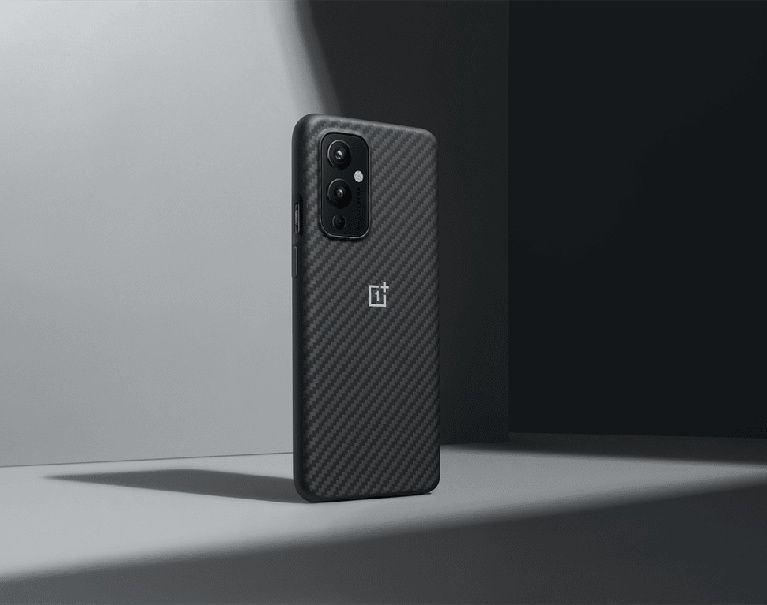
OnePlus has also launched a couple of new first-party cases with the OnePlus 9 lineup. These include a Karbon Protective case that features a carbon fiber finish on the back, a Sandstone Bumper case featuring the classic OnePlus Sandstone finish, and a silver Droid Case.


Warp Charge 50 Wireless charger
OnePlus has also launched a Warp Charge 50 Wireless charger for the OnePlus 9 Pro. It can charge the phone from 1-100% in just 43% minutes and it features two charging coils, allowing you to charge the phone in both portrait and landscape orientation.
Third-Party Cases and Accessories
If you’re looking for more cases and accessory options to go along with your new OnePlus 9 series purchase, here are our recommendations:
OnePlus 9 series: Pricing & Availability
The OnePlus 9 series is priced as follows:
| Sr. No. |
Device |
North America |
Europe |
India |
China |
| 1. |
OnePlus 9: |
|
|
|
|
| 1.1 |
8GB + 128GB
(Astral Black, Winter Mist) |
|
€709 |
₹49,999 |
¥3,799 |
| 1.2 |
12GB + 256GB
(Astral Black) |
|
€809 |
₹54,999 |
¥4,299 |
| 2. |
OnePlus 9 Pro: |
|
|
|
|
| 2.1 |
8GB + 128GB
(Morning Mist) |
|
€909 |
₹64,999 |
¥4,999 |
| 2.2 |
8GB + 256GB |
– |
– |
– |
¥5,499 |
| 2.3 |
12GB + 256GB
(Morning Mist, Pine Green) |
|
€999 |
₹69,999 |
¥5,999 |
| 3. |
OnePlus 9R: |
|
|
|
|
| 3.1 |
8GB + 128GB
(Lake Blue, Carbon Black) |
– |
– |
₹39,999 |
– |
| 3.2 |
12GB + 256GB
(Lake Blue, Carbon Black) |
– |
– |
₹43,999 |
– |
Both the flagship phones will be available for pre-order from March 26th in North America, with the first open sale scheduled for April 2nd. Interested buyers will be able to get their hands on unlocked units from OnePlus’ website and other major eCommerce platforms, like Amazon, Best Buy, and B&H. The Morning Mist OnePlus 9 Pro in the 12GB+256GB configuration and the OnePlus 9 (8GB+128GB) in the Winter Mist and Astral Black colorways will also be available via T-Mobile on the same dates. The OnePlus 9R will be available for pre-order in India early in April. We’ll update this post as soon as we receive more information about the availability.
Best OnePlus 9 deals: Where to buy the Oneplus 9 series of phones!
Now that you know everything about the OnePlus 9 series, check out Mishaal’s detailed review (linked below) of the OnePlus 9 Pro to see how exactly the device stacks up in real-world use.
OnePlus 9 Review: Cementing OnePlus as a Premium Phone Brand
The vanilla OnePlus 9 is for those who want flagship performance but don't want to pay top dollar. It offers a 6.5-inch 120Hz AMOLED display, a triple-camera setup tuned by Hasselblad, and the Snapdragon 888 SoC.
With a large, 6.7-inch Quad HD OLED display and a Smart 120Hz refresh rate, the OnePlus 9 Pro may have the best display on the market. The cameras, tuned in collaboration with Hasselblad, produce excellent still photos and capture superb 4K video.
The OnePlus 9R is a rehashed OnePlus 8T with Qualcomm's Snapdragon 870 chip and a redesigned camera island. It's the most affordable phone in the OnePlus 9 lineup and it has the potential to be the most popular out of the lot.
The post OnePlus 9 series: Everything you need to know about OnePlus’ latest flagships appeared first on xda-developers.
from xda-developers https://ift.tt/3aX7vCf
via
IFTTT