LightBlog

jeudi 11 juin 2020

Android 11 upgrades Voice Access to understand screen content, and the results are amazing

Google will release Android 11 this fall season. But, as per the usual tradition, Google has been rolling out Developer Previews for the upcoming version of Android. They even released a fourth Developer Preview back in May to compensate for the unavoidable cancellation of the Google I/O conference due to the global pandemic. Yesterday, Google announced the first Android 11 beta which brings a lot of new functional improvements, privacy features, and a few minor but aesthetic UI improvements.

Android 11 Beta 1 rolled out early to some Pixel 4 users: Here’s what’s new

Besides adding new features, Google has also improved certain existing ones like “Voice Access,” which is an accessibility feature that lets you control the phone without using your hand. As you can imagine, this is designed for users with motor disabilities. These users can simply use their voice to complete basic functions like opening any app, scrolling on the page, or interacting with various responsive elements on the current page by saying the name or the number assigned to each of those elements to make interaction easier.

The Voice Access feature isn’t really new and has been available for over two years. But with the Android 11 beta, Voice Access is becoming more fluid and intuitive, allowing you to just say the name of the thing you want to tap on instead of the number. Dieter Bohn from The Verge has a very informative demo of the feature in the tweet embedded below:

Voice Access is not limited to Android 11 and works with any device running Android 5.0 Lollipop and above. To access the feature, you need to download the app from the Play Store.

Voice Access (Free, Google Play) →

Notably, Apple also has a similar feature called Voice Control which is available for iOS and macOS. The feature as you can see in the promo below is claimed to work flawlessly.

The post Android 11 upgrades Voice Access to understand screen content, and the results are amazing appeared first on xda-developers.


from xda-developers https://ift.tt/2AoFaXn
via IFTTT

[Update 3: June 15 Sale] OnePlus 8 and OnePlus 8 Pro launched in India, starting at ₹41,999 ($549)

Update 3 (06/11/2020 @ 03:47 AM ET): The OnePlus 8 Pro is going on its first sale in India on June 15, 2020.

Update 2 (05/27/2020 @ 11:16 AM ET): OnePlus has delayed the availability of the OnePlus 8 and OnePlus 8 Pro in India.

Update 1 (05/14/2020 @ 01:48 AM ET): OnePlus has shared availability details for the OnePlus 8 and OnePlus 8 Pro in India. Scroll to the bottom for more information. The article as published on April 19, 2020, is preserved below.

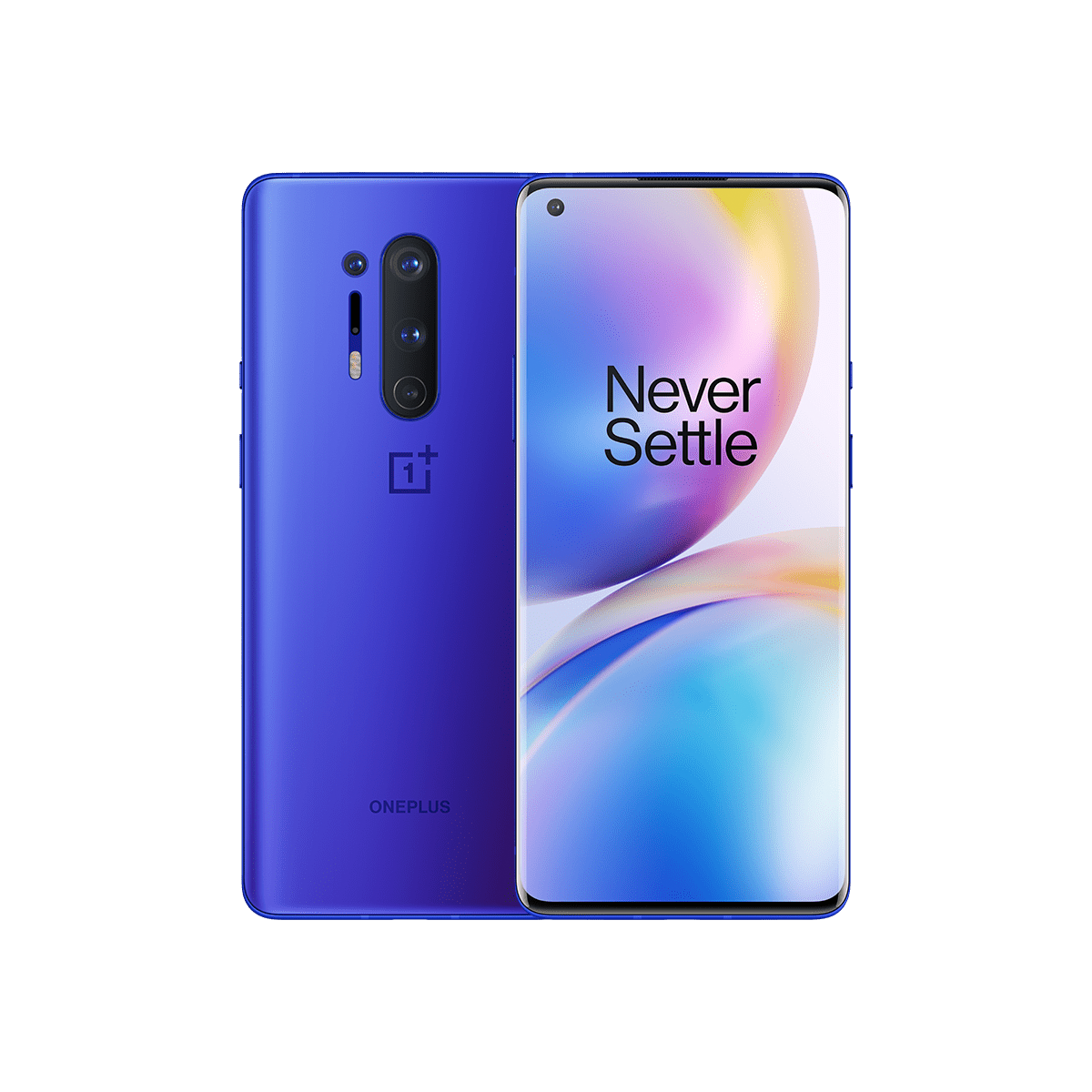
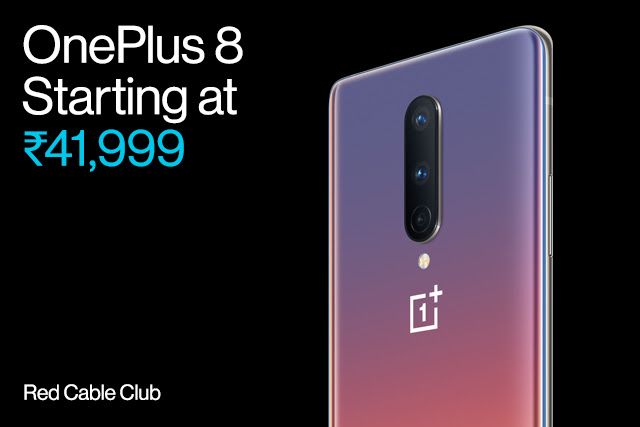
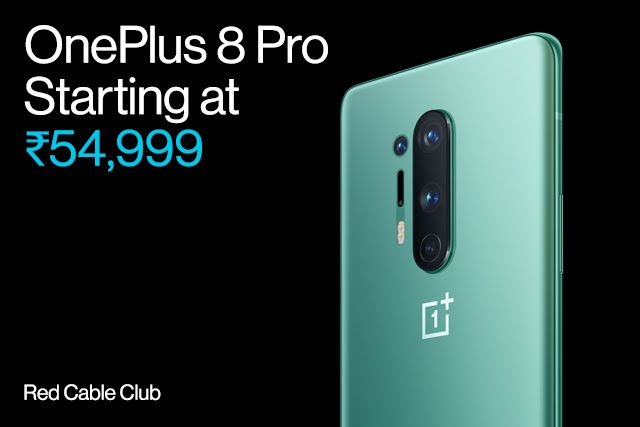
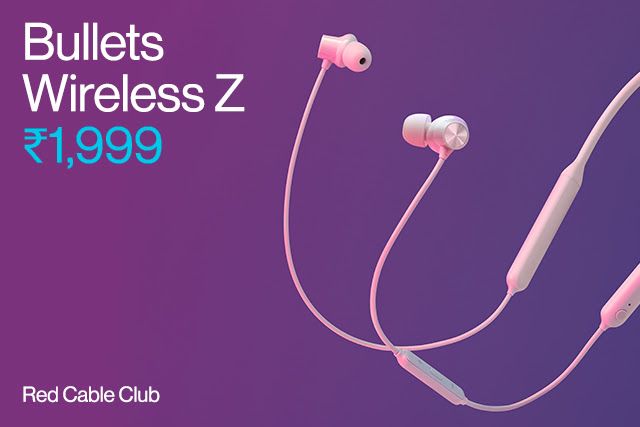
After months of leaks and teasers, OnePlus finally launched the OnePlus 8 series earlier this month. However, unlike previous years, the company didn’t launch the OnePlus 8 series in India and China at the same time as the global launch. While OnePlus launched the devices in China just a day after the global launch, the company has now finally gotten around to launching the OnePlus 8, OnePlus 8 Pro, and OnePlus Bullets Wireless Z in India.

OnePlus 8 OnePlus 8 Pro

OnePlus 8 XDA Forums || OnePlus 8 Pro XDA Forums

OnePlus 8 Series Specifications

Full Specification Table

Specification OnePlus 8 OnePlus 8 Pro
Dimensions & Weight
  • 160.2 x 72.9 x 8.0 mm
  • 180g
  • 165.3 x 74.35 x 8.5 mm
  • 199g
Colors, Materials, Finish
  • Onyx Black (glossy)
  • Glacial Green (matte-frosted)
  • Interstellar Glow (glossy)
  • Polar Silver
  • Onyx Black (glossy)
  • Glacial Green (matte-frosted)
  • Ultramarine Blue (matte-frosted)
Display
  • 6.55″ Fluid AMOLED, single hole-punch (3.8mm) cutout
  • FHD+ resolution (2400 x 1080), 20:9 aspect ratio, 402ppi
  • 90Hz refresh rate, 180Hz touch sampling rate
  • HDR10+
  • 3D Corning Gorilla Glass
  • Features
    • Vibrant Color Effect
    • Reading Mode
    • Night Mode
  • No Active Digitizer for Active Pen support
  • 6.78″ Fluid AMOLED, single hole-punch (3.8mm) cutout
  • QHD+ resolution (3168 x 1440), 19.8:9 aspect ratio, 513ppi
  • 120Hz refresh rate, 240Hz touch sampling rate
  • HDR10+
  • 1300 nits peak brightness, 4096 levels of adjustment
  • 3D Corning Gorilla Glass
  • Features
    • Vibrant Color Effect
    • Reading Mode
    • Night Mode
    • MEMC
    • HDR Boost
    • Adaptive Display
  • No Active Digitizer for Active Pen support
Cameras (Rear)
  • Primary
    • 48MP Sony IMX586, f/1.75, 0.8µm pixels, OIS, EIS
  • Secondary
    • 16MP, ultra-wide-angle, f/2.2, 116° FOV
  • Tertiary
    • 2MP, macro, f/2.4, 1.75µm pixels
  • Flash
    • Dual LED Flash
  • Autofocus
    • PDAF + CAF
  • Video
    • 4K @ 30/60 fps
    • 1080p @ 30/60 fps
    • Slow Motion
      • 1080p @ 240 fps
      • 720p @ 480 fps
    • Time Lapse
      • 4K @ 30 fps
      • 1080p @ 30 fps
    • Miscellaneous features
      • CINE aspect ratio
      • Ultra Steady at 4K @ 30 fps
  • Other sensors
    • Flicker ambient light sensor (front)
  • Primary
    • 48MP Sony IMX689, f/1.7, 1.12µm pixels/48MP; 2.24µm [4 in 1]/12MP, OIS, EIS
  • Secondary
    • 48MP, ultra-wide-angle, f/2.2, 119.7° FOV
  • Tertiary
    • 8MP, telephoto, f/2.4, 1.0µm pixels, OIS, 3x Optical Hybrid Zoom
  • Quaternary
    • 5MP, color filter, f/2.4
  • Flash
    • Dual LED Flash
  • Autofocus
    • All pixel omni-directional PDAF+CAF+LAF
  • Video
    • 4K @ 30/60 fps
    • 1080p @ 30/60 fps
    • Slow Motion
      • 1080p @ 240 fps
      • 720p @ 480 fps
    • Time Lapse
      • 4K @ 30 fps
      • 1080p @ 30 fps
    • Miscellaneous features
      • HDR Video, CINE aspect ratio
      • Ultra Steady at 4K @ 30 fps
      • Audio Zoom
      • Audio 3D
      • Audio Windscreen
      • Color Filter Camera
  • Other sensors
    • Flicker ambient light sensor (front and back)
    • Laser sensor
    • Front RGB sensor
Camera (Front) 16MP Sony IMX471, f/2.0, 1.0µm pixels, fixed focus, EIS, 1080p@30fps 16MP Sony IMX471, f/2.45, 1.0µm pixels, fixed focus, EIS, 1080p@30fps
Software OxygenOS 10 based on Android 10

2 years of software updates (Android 11 and Android 12 planned), 3 years of bi-monthly security updates

A/B partitions for Seamless Updates

System-on-chip Qualcomm Snapdragon 865 CPU

1x Kryo 585 (ARM Cortex-A77-based) Prime core @ 2.84GHz
3x Kryo 585 (ARM Cortex-A77-based) Performance core @ 2.4GHz
4x Kryo 385 (ARM Cortex A55-based) Efficiency cores @ 1.8GHz

Adreno 650 GPU

RAM 8/12GB LPDDR4X 8/12GB LPDDR5
Storage 128/256 GB UFS 3.0+ Dual-Lane
Battery 4300 mAh 4510 mAh
Wired Charging 30W Warp Charge 30T (5V/6A)

15W USB-C Power Delivery (5V/3A)

Wireless Charging No Warp Charge 30 Wireless (30W), 10W Qi EPP

Reverse Wireless Charging (3W)

IP Rating No IP68
Security

Optical under-display fingerprint scanner

Software-based facial recognition

Ports & Buttons

USB 3.1 (Gen 1) Type-C with video out (DisplayPort Alternate Mode)

Alert Slider

Dual nano-SIM slot*

*Second SIM will be activated in a post-launch update

Audio & Vibration Dual stereo speakers. Audio tuned by Dolby Atmos.

X-axis linear motor

Multimedia Codec Support

Audio Playback: MP3, AAC, AAC+, WMA, AMR-NB, AMR-WB, WAV, FLAC, APE, OGG, MIDI, M4A, IMY, AC3, EAC3, EAC3-JOC, AC4

Audio Recording: WAV, AAC, AMR

Video Playback: MKV, MOV, MP4, H.265(HEVC), AVI, WMV, TS, 3GP, FLV, WEBM

Video Recording: MP4

Image Viewing: JPEG, PNG, BMP, GIF, WEBP, HEIF, HEIC, RAW

Image Output: JPEG, PNG

Connectivity
  • Qualcomm Snapdragon X55 modem + Qualcomm FastConnect 6800
  • Wi-Fi: 2×2 MIMO, 802.11 a/b/g/n/ac/ax, 2.4GHz/5GHz
  • Bluetooth: Bluetooth 5.1, with Qualcomm aptX, Qualcomm aptX HD, LDAC and AAC
  • NFC: Yes
  • Positioning: GPS (L1+L5 dual-band), GLONASS, BeiDou, Galileo (E1+E5a dual-band), SBAS, A-GPS
  • LTE/LTE-A:
    • 4x4MIMO
    • Supports up to DL Cat 18 (1.2Gbps)/UL Cat 13 (150Mbps) depending on carrier.
  • Bands (NA)
    • 5G NSA: n2, n5, n66, n71, n41
    • 5G SA: n71, n41
    • MIMO-LTE: B2, 4, 7, 25, 66, 41, 48
    • NR: n2, n66, n41
    • FDD-LTE: B1, 2, 3, 4, 5, 7, 8, 12, 13, 17, 18, 19, 20, 25, 26, 28, 29, 30, 66, 71
    • TDD-LTE: B34, 38, 39, 40 (Roaming), 41, 46, 48
    • GSM: 850, 900, 1800, 1900
    • WCDMA: B1, B2, B4, B5, B8, B9, B19
    • CDMA: BC0, BC1, BC10
  • Bands (IN)
    • 5G NSA: n78
    • 5G SA: n78
    • MIMO-LTE: B1, 3, 41, 40
    • NR: n78
    • FDD-LTE: B1, 2, 3, 4, 5, 7, 8, 12, 17, 18, 19, 20, 26
    • TDD-LTE: B34, 38, 39, 40, 41, 46
    • WCDMA: B1, B2, B4, B8, B9, B19
    • CDMA: BC0 (Roaming)
    • GSM: 850, 900, 1800, 1900
  • Bands (EU)
    • 5G NSA: n1, n3, n28, n78
    • 5G SA: n78
    • MIMO-LTE: B1, 3, 7, 38, 40, 41
    • NR: n1, n3, n7, n78
    • FDD-LTE: B1, 2, 3, 4, 5, 7, 8, 12, 13, 17, 18, 19, 20, 25, 26, 28, 32, 66
    • TDD-LTE: B34, 38, 39, 40, 41, 42, 46
    • WCDMA: B1, B2, B4, B5, B8, B9, B19
    • CDMA: BC0
    • GSM: 850, 900, 1800, 1900

Indian Pricing

India is currently in the middle of a lockdown because of COVID-19, because of which, many OEMs have had to shelve their plans. Nonetheless, the company is going ahead with a price reveal.

OnePlus 8 OnePlus 8 Pro OnePlus Bullets Wireless Z

The OnePlus 8 series will be available in the following RAM and storage variants at the below-mentioned prices:

  • OnePlus 8:
    • 6GB + 128GB: ₹41,999 (Amazon.in exclusive) (Glacial Green)
    • 8GB + 128GB: ₹44,999 (Onyx Black, Glacial Green)
    • 12GB + 256GB: ₹49,999 (Onyx Black, Glacial Green, Interstellar Glow)
  • OnePlus 8 Pro:
    • 8GB + 128GB: ₹54,999 (Onyx Black, Glacial Green)
    • 12GB + 256GB: ₹59,999 (Onyx Black, Glacial Green, Ultramarine Blue)
  • OnePlus Bullets Wireless Z: ₹1,999 (Black, Blue, Mint, Oat)

XDA Review: OnePlus 8 || OnePlus 8 Pro

Interestingly, India gets a lower RAM variant and an even lower starting price point ($549). Even the matching variants are priced lower in India. For instance, the starting 8GB + 128GB variant of the OnePlus 8 costs ~$588, which is a good ~$100 cheaper than the US pricing of $699. Similarly, the OnePlus 8 Pro’s 12GB + 256GB variant costs ~$785, which is a far cry from the $999 price tag for the top variant. Even the OnePlus Bullets Wireless Z is half the price. Keep in mind that the Indian variant lacks some 5G bands, which is a non-issue for India because the country does not have 5G anyway.

The phones and accessories will be available across all online and offline channels when the sale is made possible in India in line with the government’s COVID-19 advisories.

Here is the complete price chart for major markets:

Device USD UK EU India
OnePlus 8 – 6GB RAM + 128GB storage: Glacial Green ₹41,999 (~$549)
OnePlus 8 – 8GB RAM + 128GB storage: Onyx Black, Glacial Green $699 £599 €699 ₹44,999 (~$589)
OnePlus 8 – 12GB RAM + 256GB storage: Interstellar Glow $799 £699 €799 ₹49,999 (~$654)
OnePlus 8 – 12GB RAM + 256GB storage: Onyx Black, Glacial Green ₹49,999 (~$654)
OnePlus 8 – 8GB RAM + 128GB storage: Polar Silver* $799
OnePlus 8 Pro – 8GB RAM + 128GB storage: Glacial Green, Onyx Black $899 £799 €899 ₹54,999 (~$719)
OnePlus 8 Pro – 12GB RAM + 256GB storage: Glacial Green, Onyx Black ₹59,999 (~$785)
OnePlus 8 Pro Ultramarine Blue (12GB RAM + 256GB storage) $999 £899 €999 ₹59,999 (~$785)

*Exclusive to Verizon Wireless in the U.S.


Update: OnePlus 8 and OnePlus 8 Pro availability in India

The OnePlus 8 and OnePlus 8 Pro will be available on open sale in India on May 29, 2020 across Amazon.in, oneplus.in, and select OnePlus exclusive offline stores and partner outlets. The OnePlus 8 will also be made available in limited quantities in a special early access sale on Amazon.in on May 18, 2020, at 2 pm IST. The phones are currently available for pre-booking on Amazon.in.

Pre-book OnePlus 8 series on Amazon.in and get ₹1,000 cashback

In addition to the pre-booking offer, there are a few launch offers as well. Customers using an SBI Credit Card can get an instant discount of ₹2,000 and ₹3,000 on the OnePlus 8 and OnePlus 8 Pro respectively. No-cost EMI options are also available across all channels on popular bank debit and credit cards. Reliance Jio users will also be getting ₹150 off on 40 prepaid recharges of ₹349, making it a good deal for their continued data usage.

OnePlus is also offering a Limited Edition pop-up bundle, which will include the device along with a Bullets Wireless Z (Black) earphones, a Cyan Bumper case, and a Karbon Bumper Case at an additional ₹1,000 above the retail price of just the device. The pop-up bundle is available on an invite-only basis for Red Cable Club members initially and will be opened up on select channels later on. Red Cable Club members also get a few other discounts, such as on extended warranty, battery replacement, and assured buyback protection.


Update 2: Open sales delayed

The open sales for the OnePlus 8 and OnePlus 8 Pro in India were scheduled for May 29, 2020. Unfortunately, OnePlus has now announced that the open sales for the devices have now been postponed indefinitely.

OnePlus 8 Pro Sales in India

The announcement post mentions that production was temporarily halted. The reason has not been specified, but external sources suggest it is because of workers testing positive for COVID-19 at the assembling facility. The OnePlus 8 and OnePlus 8 Pro for the Indian region are assembled in India, which is the reason why they are priced competitively, relatively speaking.

Production for the devices is back up and running, but the delay has altered the sales plan. Consequently, the devices will not go on open sale on the mentioned date. Instead, the OnePlus 8 will be available in very limited quantity on the date. Further information on the open sales schedule will be communicated soon.


Update 3: OnePlus 8 Pro goes on its first sale on June 15, 2020

The OnePlus 8 Pro is finally going on its first sale in India, on June 15, 2020 at 12 noon. However, since the product is expected to have high demand and there have been stocking issues, we presume that the product will sell out quite early owing to its presumed limited quantities.

Source: Ishan Agarwal

The post [Update 3: June 15 Sale] OnePlus 8 and OnePlus 8 Pro launched in India, starting at ₹41,999 ($549) appeared first on xda-developers.


from xda-developers https://ift.tt/2KjunyW
via IFTTT

Xiaomi Mi Notebook 14, Mi Notebook 14 Horizon Edition launched in India, starting at ₹41,990

Xiaomi entered the laptop market all the way back in 2016, with the launch of the Mi Notebook Air in China. Since then, the company has launched several laptops in its home country, including the Mi Notebook lineup and the Mi Gaming laptop. However, despite receiving constant requests from its fans in India, the company hasn’t launched any of its laptops in the country so far. That changes today, as the company has now officially announced the Mi Notebook 14 and Mi Notebook 14 Horizon Edition for the Indian market.

Mi Notebook 14 Horizon Edition

The Mi Notebook 14 Horizon Edition is a thin and light laptop powered by Intel’s 10th-Gen Comet Lake processors. The laptop features a design similar to the MacBook Pro, with a brushed metal body built from an aluminum and magnesium alloy. It houses a 14-inch FHD display in the footprint of a 13.3-inch laptop, with 3mm slim bezels on the top and sides. This gives the laptop a 91% screen to body ratio, which is among the highest in the industry.

Mi Notebook 14 Horizon Edition pricing

The Mi Notebook 14 Horizon Edition will be available with either an Intel Core i5 10210U or a Core i7 10510U processor, 8GB of DDR4 RAM, 512GB of M.2 NVMe storage, and an Nvidia GeForce MX350 GPU. In terms of I/O, the laptops feature 2 USB 3.1 Type-A ports, a USB 2.0 Type-A port, a USB Type-C port, a headphone/microphone combo jack, and an HDMI 1.4 port. Connectivity options include Wi-Fi 802.11ac 2×2 and Bluetooth 5.0.

Powering the laptop is a 46Wh battery which is rated for up to 10 hours of use on a single charge. Xiaomi has included a 65W fast charger in the box, which is capable of charging the laptop up to 50% in just over 30 minutes.

In terms of software, the Mi Notebook Horizon Edition runs Windows 10 Home Edition, which comes with an Office 365 30-day trial. Unlike its smartphones, Xiaomi has limited its own additions to two useful features — Mi Blaze Unlock and Mi Smart Share. The Mi Blaze Unlock feature will allow users to unlock their laptops using a Mi Band, while the Mi Smart Share feature will allow users to share files between devices.

Mi Notebook 14

The regular Mi Notebook 14 features a similar design, however, it doesn’t include the slim bezels offered on the Horizon edition. The top and side bezels on the Mi Notebo0k 14 are noticeably thicker and, therefore, it has a larger footprint.Mi Notebook 14 pricing

In terms of hardware, the Mi Notebook 14 will only be available with an Intel Core i5 10210U chip, coupled with 8GB of DDR4 RAM, up to 512GB of SATA 3 SSD storage, and an Nvidia GeForce MX250 GPU on the top-end variant. The other two variants will offer Intel UHD Graphics 620.

Pricing and Availability

Both the Mi Notebook 14 and Mi Notebook 14 Horizon Edition will go on sale starting from June 17th via mi.com, amazon.in, Mi Home and Mi Studio stores. The Mi Notebook 14 will be available at a starting price of ₹41,990 (~$550) for the Core i5, Intel UHD graphics 620, and 256GB storage variant. The Core i5, Intel UDH Graphics 620, and 512GB storage variant will be available for ₹44,999 (~$590), and the Intel Core i5, Nvidia MX250, and 512GB storage variant will be available for ₹47,999 (~$630). It’s worth noting that these are inaugural prices that are valid until July 16th and we currently have no information on the final pricing for the Mi Notebook 14.

The Mi Notebook 14 Horizon Edition, on the other hand, will start at ₹54,999 (~$725) for the Core i5, Nvidia MX350, and 512GB storage variant, while the Core i7, Nvidia MX350, and 512GB storage variant will be available for ₹59,999 (~$790). Xiaomi has also announced a launch offer which will get buyers an instant discount of ₹2,000 on the use of an HDFC Bank credit/debit card. It’s also worth noting that since both laptops don’t include a built-in webcam, Xiaomi will ship an external HD webcam in the box with each notebook purchase.

The post Xiaomi Mi Notebook 14, Mi Notebook 14 Horizon Edition launched in India, starting at ₹41,990 appeared first on xda-developers.


from xda-developers https://ift.tt/37kK1op
via IFTTT

Xiaomi Mi Band 5 launches with 1.2″ color screen, NFC, and magnetic charging

Xiaomi’s Mi Band series is highly praised in the fitness tracker segment for offering several value features at a very affordable price. With each new generation, the Mi Band fitness trackers gain new functionality compelling existing users to upgrade and new users to get onboard. Last year on June 11th, Xiaomi announced the Mi Band 4 with a colored OLED display and support for a plethora of official and third-party watchfaces for just about $30 and its value allowed Xiaomi to sell a million units in just a week after its launch. Exactly after a year, Xiaomi is launching Mi Band 4’s successor – the Mi Band 5 – with a larger colored AMOLED display, improved fitness tracking, and a magnetic charging dock.

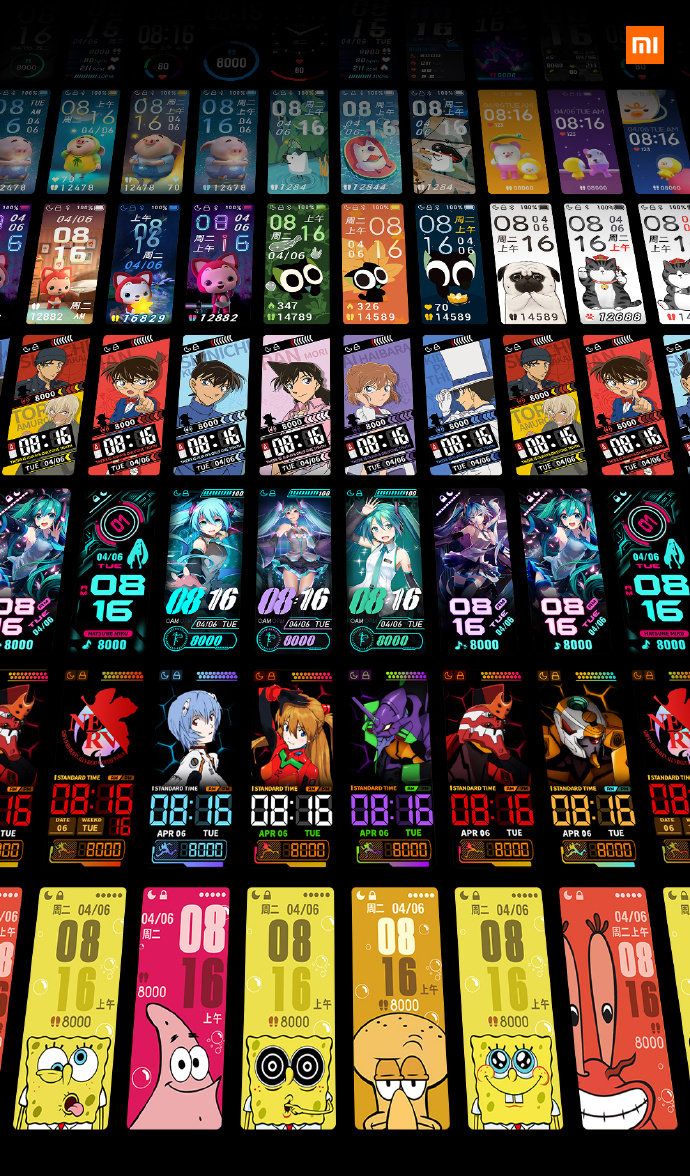
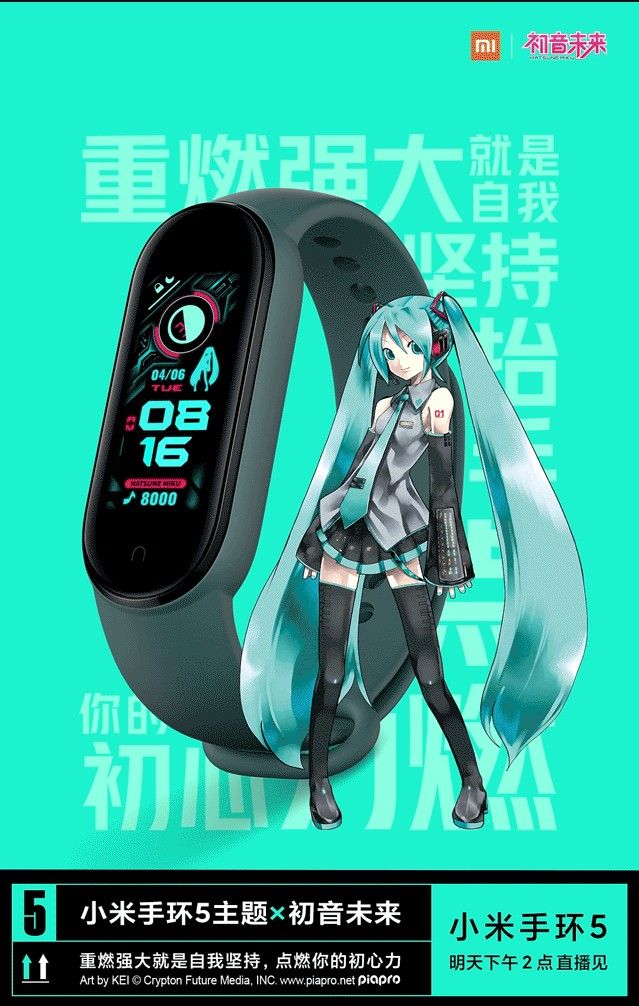
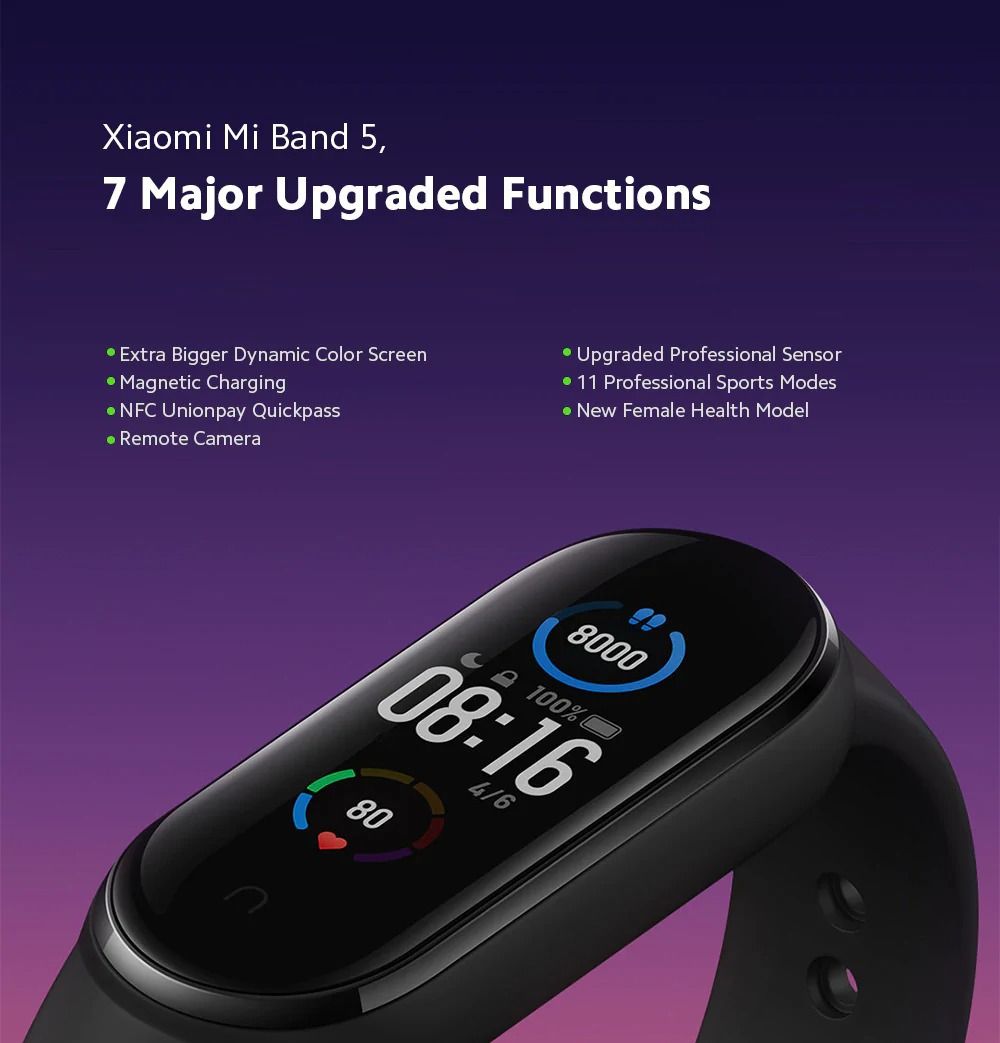
Quite evidently, the first feature to grab users’ attention will be the slightly larger display. The upgraded display on the Mi Band 5 measures 1.2″ diagonally and stretches across a 20% bigger area than 0.95″ display on the previous generation. With this, the Mi Band 5 will also get 100+ new animated watchfaces with characters from popular animated series such as Neon Genesis Evangelion, Case Closed, Hatsune Miku, and SpongeBob SquarePants.

The animated watchfaces from these franchises will be accompanied by matching colored bands as seen in the images below:

mi band 5 special edition xiaomi fitness tracker band xiaomi fitness tracker band mi band 5 spongebob squarepants

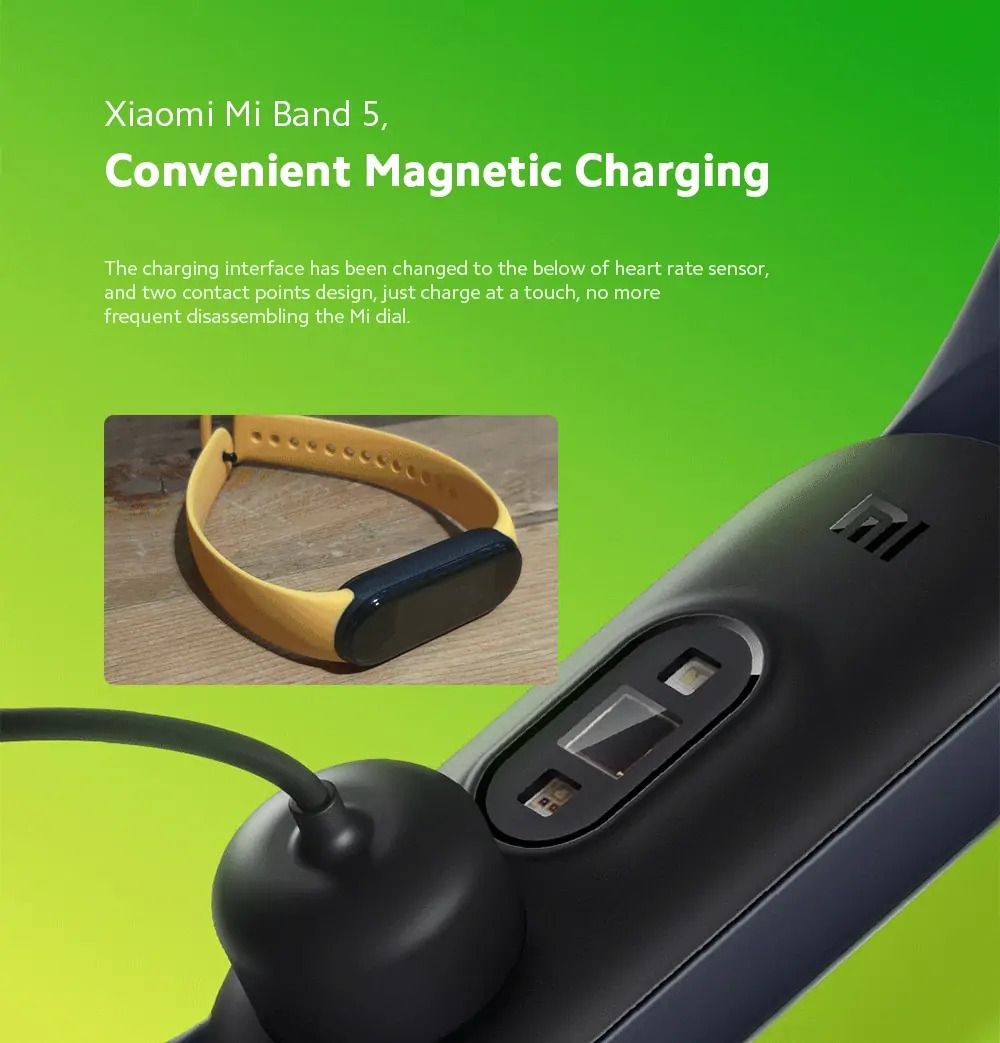
The second massive design change is the new magnetically attaching charging dock. Two electrodes stick out of the bottom part of the Mi Band 5 to which the charging dock automatically hooks – even though it will not be backwards compatible with the older generations for which the tracker had to be taken out of the strap and placed into a charging cradle. The new magnetic charging dock eliminates the need for taking the tracker out of the strap or ensuring that it sits properly on the cradle – which has been a problem for older versions just as Aamir mentioned in his Mi Band 4 review.

xiaomi mi band 5 charging dock xiaomi mi band 5 display

Xiaomi is launching some new dual-toned straps along with the band. These new bands with the black part wrapping the fitness tracker might set off the illusion that the steps are connected to the two far ends of the body instead of being an entire removable/replaceable strap.

The Mi Band 5 also gets an improved processor for faster and more accurate tracking. Besides 11 fitness tracking modes, female users can use the fitness band to tracking their menstrual cycles. The fitness band will also offer a PAI (Personal Activity Intelligence) score to help you contextualize how physical activities contribute to your fitness. For more efficient sleep tracking, the Mi Band 5 will now also report REM sleep beside deep and light sleep.

Further, the tracker also comes with an inbuilt barometer to gauge the atmospheric pressure and can also be used as a remote shutter button for taking images on the phone from a distance.

Just like the older versions, the fitness band will also support NFC payments in China.

Price & Availability

Xiaomi will start selling the Mi Band 5 in China starting June 18th. The non-NFC variant is priced at CNY 189 (~$27) while the NFC version will be sold for CNY 229 (~$32).

Xiaomi Mi Band 5 Specifications

Specs Mi Band 5
Size and weight TBA
Materials Polycarbonate
Wrist band Silicone
Compatibility Android, iPhone
SoC unspecified
RAM/Storage unspecified
Network NA
Display 1.2-inch AMOLED ( x  px)
Connectivity Bluetooth v5
GPS NA
Sensors Heart rate sensor, accelerometer, barometer, proximity sensor
NFC payments Yes
Battery mAh
Water resistance 50m up to 30 minutes in freshwater


The post Xiaomi Mi Band 5 launches with 1.2″ color screen, NFC, and magnetic charging appeared first on xda-developers.


from xda-developers https://ift.tt/2zlTuiM
via IFTTT

Realme Band’s v8.0 update finally adds music controls, stopwatch, and a heart rate reminder function

Realme launched the Realme Band in India alongside the Realme 6 series, in March 2020. For the company, the Band represented its first attempt at piercing into a market that has seen domination from the likes of the Mi Band, staying true to the company’s attempt at competing with Xiaomi across all product segments. While ambitions were high and the stakes even higher, the Realme Band was visibly a first-generation product, with shortcomings that dragged it down from being a true competitor worthy of recommendation. Realme has attempted to fix the imperfections with software updates for the Band, and the latest Realme Band v8.0 update brings over music controls, stopwatch, and a heart rate reminder to the company’s first fitness tracker.

The v8.0 firmware update for the Realme Band comes with the following changelog:

  • Add Heart Rate reminder function
  • Add Music Control function
  • Add Stopwatch function
  • Fix some known bugs

The fine print mentions that the Realme Band can only support two of the features at a time i.e. only two can be displayed, which is a bummer.

One of the biggest downsides with the Realme Band was its poor display brightness, which rendered the display rather useless when outdoors. Realme attempted to “fix” the issue with a software update that ramped up the brightness. While the brightness did increase, it still is nowhere enough to stand its own ground when out and about in the sun. This experience is in contrast with the company’s audio accessories, namely truly wireless earbuds in the form of the Realme Buds Air and Realme Buds Air Neo, which have performed admirably for their price point.

Realme Buds Air TWS XDA Review: Desirable truly wireless audio meets Realme’s reliability

Realme has also launched its second fitness product, the Realme Watch, which seemingly competes against the Amazfit Bip S in India.

The post Realme Band’s v8.0 update finally adds music controls, stopwatch, and a heart rate reminder function appeared first on xda-developers.


from xda-developers https://ift.tt/37iqFQO
via IFTTT

mercredi 10 juin 2020

Adobe Photoshop Camera is now available for download on the Google Play Store

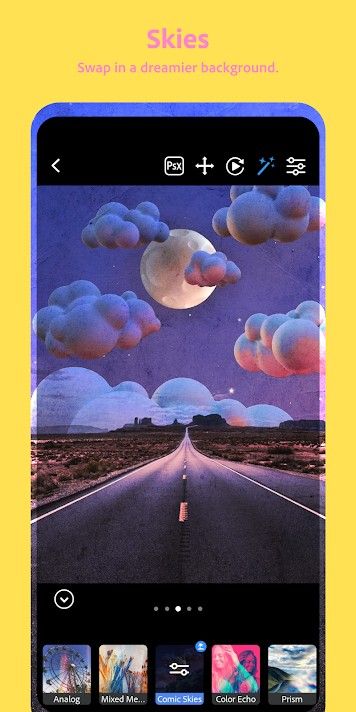
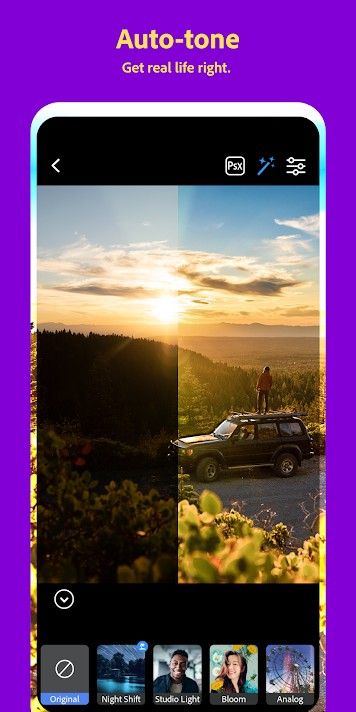
The AI-powered Adobe Photoshop Camera app, which was announced late last year in November, is now available for download on the Google Play Store. The latest app from Adobe joins the long list of third-party camera apps available on the Play Store, but it has something unique to offer. The app makes use of Adobe’s artificial intelligence platform Sensei to recognize subjects in your photos and recommends the best filters that you can use to take your photos to the next level. We got our first look at the app back in December last year when Adobe released a preview version and we were quite impressed by its capabilities. Now, you can follow the Play Store link below to try it out for yourself.

Adobe Photoshop Camera Adobe Photoshop Camera Adobe Photoshop Camera

The Photoshop Camera app aims to simplify the way you edit your photos by providing a variety of features that will help you make adjustments with minimal effort on your part. The app offers over 80 custom filters that you can try either in real-time on the viewfinder or while editing your photos at a later stage. These include filters like Portrait, Studio Light, Bloom, Pop Art, Spectrum, Desync, Food, Scenery, Natural Skies, and more. Along with the filters, the app also offers real-time Photoshop effects that will help you capture better photos using AI-powered editing, an auto-tune feature to automatically adjust brightness and shadows, content-aware recommendations, auto-masking, and portrait controls.

Furthermore, the app offers influencer-inspired lenses that will help you edit your photos using custom-designed lenses from your favorite creators. Adobe has already roped in Billie Eilish, who has released a limited edition lens for the app that you can try right away. In case you don’t like any of the influencer lenses, you also get the option to create your own and share them with other users on the app.

Adobe Photoshop Camera (Free, Google Play) →

The post Adobe Photoshop Camera is now available for download on the Google Play Store appeared first on xda-developers.


from xda-developers https://ift.tt/3dTYqub
via IFTTT

Redmi Earbuds S Review: Inarguably the best entry-level TWS earbuds

While truly wireless earbuds have been around for several years now, a lot of the good options out there are pricey while most of the affordable ones are rather unimpressive. Xiaomi aims to change that with its new Redmi Earbuds S which were launched in India late last month. Priced at ₹1,799, the Redmi Earbuds S seem to be a great pair of wireless earbuds, at least on paper. But with so many mediocre options currently available in this price segment, it’s natural for one to be skeptical of Xiaomi’s new wireless earbuds. However, after using the Redmi Earbuds S extensively over the last two weeks, I can assure you that they’re easily one of the best, if not the best, TWS earbuds that you can get at this price point.

The Redmi Earbuds S check almost all the boxes for a good pair of TWS earbuds thanks to their compact and comfortable design, decent audio output, and a good selection of features. While the earbuds aren’t perfect by any means, almost all of the shortcomings can be overlooked when the price is taken into account, and that’s exactly what makes the earbuds a great buy. That being said, here’s our review of the Redmi Earbuds S.

Note: Xiaomi India sent us a pair of Redmi Earbuds S for review. However, the company did not have any input into the content of this review.

Design

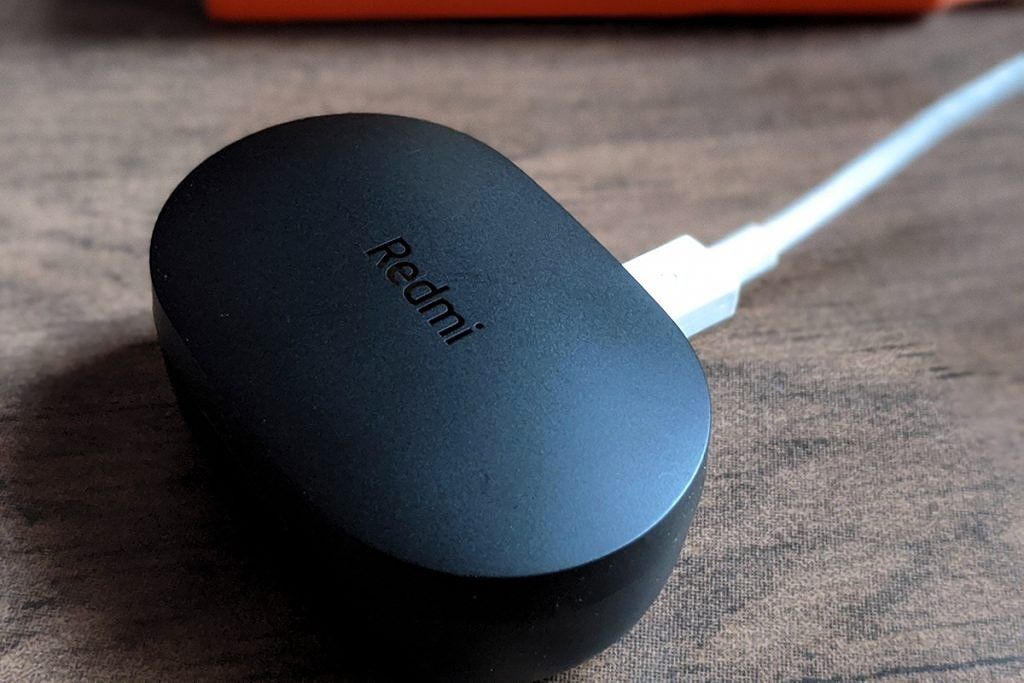
The Redmi Earbuds S come in a compact pill-shaped charging case that has a matte black finish and minimal Redmi branding on the lid. The case features a micro-USB port for charging, precise cutouts with magnets to safely house the earbuds, and a magnetic lid to keep everything secure when the earbuds are not in use. The case doesn’t include any buttons or indicator LED, with the latter meaning that there’s no way to tell the current battery level of the case.
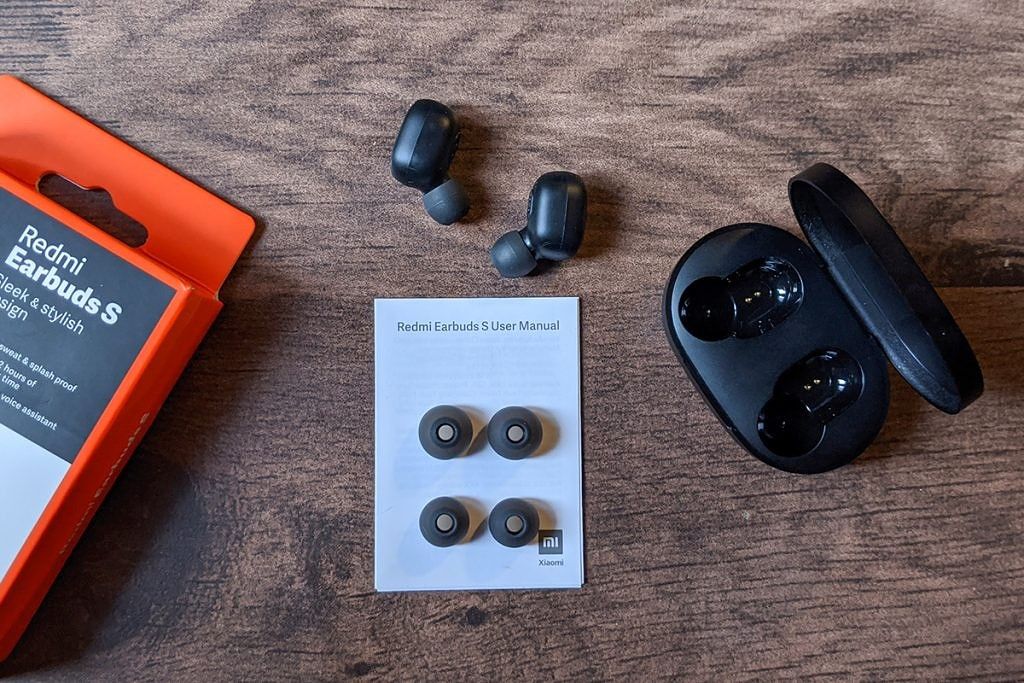
The earbuds are also pill-shaped and have the same matte black finish. Each earbud has a single tactile button on the outer surface, which also houses the indicator LEDs. The LEDs glow red when the earbuds are charging, white when they’re completely charged, and blink white when they’re in pairing mode. Over on the other side, the earbuds have the charging contacts and a silicone tip. The earbuds come with the medium-sized silicone tips preinstalled and Xiaomi includes both small and large-sized tips in the box. Thanks to the silicone tips and the compact shape, the earbuds fit securely and don’t fall out even during intense workout sessions or while running. They can easily be worn for hours on end without any discomfort. The earbuds are rated IPX4 for water resistance, so they’re protected against occasional splashes and sweat, but the case itself isn’t water-resistant.

Redmi Earbuds S

As far as the design is concerned, I don’t have any major complaints with the Redmi Earbuds S. However, there are a couple of things worth noting that might be deal-breakers for you. The case is made of cheap plastic and doesn’t seem durable. It creaks and clicks when you press lightly between the earbud cutouts which made me initially think that there was an unmarked button there. The lid and hinge also feel quite flimsy, which leads me to believe that the case might not survive a fall from waist height. I haven’t tried that, though, and I would advise that you don’t try that either. It’s also worth noting that Xiaomi doesn’t ship a micro-USB charging cable with the Redmi Earbuds S which is definitely disappointing but can be written off as a cost-cutting measure.

Features

Now that we’ve got the design out of the way, let’s take a look at the features. The Redmi Earbuds S offers a substantial list of features for a pair of truly wireless earphones in this price range. Starting off with the pairing process, Xiaomi has done away with the complicated master-slave pairing process from the Mi AirDots S and has opted for a much simpler and faster pairing process for the Redmi Earbuds S. The earbuds automatically start pairing to each other as soon as you pull them out of the case and the process takes about 2-3 seconds.

Once the earbuds are paired with each other, the LED indicator slowly blinks white after which you can pair it with your smartphone. After you pair the earbuds to your smartphone, they will automatically connect to the device as soon as they’re pulled out of the case. Due to the fact that the earbuds don’t make use of a master-slave connection, they can also be used individually. To do so, you can place one of the earbuds back into the charging case and the remaining earbud will switch to the single-earbud mode. Removing the other earbud from the charging case will automatically turn on the dual-earbud mode.

As mentioned earlier, both the earbuds feature a single tactile button on the outer surface that can be used to perform a variety of functions. You can accept/end calls by clicking the button once, reject calls by pressing and holding the button for one second, play/pause music by clicking the button once, and double click to bring up the voice assistant. When you’re in a call and you receive another call, you can answer the other call by clicking the button once and switch between calls by double-clicking. To switch to your smartphone during a call, you can press and hold the button for 1 second. During an ongoing call, you can also mute/unmute the earbuds by double-clicking the button.

Additionally, the Redmi Earbuds S also features a low-latency Game Mode which can be enabled by clicking the button three times. The Game Mode greatly reduces audio delay, and Xiaomi claims that turning on the Game Mode can reduce the latency to just 122ms. In my testing, I noticed that turning on the Game Mode did, in fact, reduce the latency considerably which was quite useful while playing shooting games like PUBG Mobile and Call Of Duty: Mobile. However, the latency with Game Mode still isn’t nearly as good as when using wired earphones. Additionally, using Game Mode can take a toll on battery life, so your gaming sessions might not last all that long.

Redmi Earbuds S review

For connectivity, the Redmi Earbuds S supports Bluetooth 5.0 and includes support for the SBC Bluetooth audio codec. The earbuds also include environmental noise cancellation for voice calls for better call quality in noisy environments. While the feature set on offer is pretty extensive, there are a few features that I sorely missed on the Redmi Earbuds S. The lack of any volume adjustment and track switching options on the earbuds was a bit annoying, but that’s a sacrifice you have to be willing to make if you’re going to purchase a pair of sub-₹2,000 TWS earbuds.

Redmi Earbuds S Audio Quality

Before coming to the most crucial part of this review, the audio quality of the Redmi Earbuds S, I would like to clarify that human interpretation of audio is largely subjective and heavily depends on your preferred genre of music. This is why there’s a chance you might not agree with my observations about the audio quality of the Redmi Earbuds S.

The Redmi Earbuds S are powered by 7.2mm drivers, and Xiaomi claims that it has tuned the sound profile of the earbuds to match the music preferences of Indian buyers. In effect, this means that the earbuds offer punchy bass, muddled mids, and clean highs. Even though they’re limited to the SBC Bluetooth audio codec, the Redmi Earbuds S sound good when compared to other truly wireless earbuds in this price range. For the purpose of this review, I listened to the following playlist which consists of songs across a decent range of genres.

Playlist

  • Hometown – French 79
  • Teardrop – Massive Attack
  • Safety – Gashi (ft. DJ Snake)
  • Panda – Meute
  • Time Goes By – Kupla
  • Seven Nation Army – The White Stripes
  • Mad World – Gary Jules (ft. Michael Andrews)
  • The Blower’s Daughter – Damien Rice
  • Tadow – FKJ
  • Rockstar – Post Malone (ft. 21 Savage)
  • Young Folks – Peter Bjorn and John
  • Wasted Years – Iron Maiden
  • Purusha – NVDES
  • Parallel Jalebi – Four Tet
  • Who We Want to Be – Tom Day

Note: The lack of Bollywood tracks on my list is due to my personal bias. I did not want to listen to music that doesn’t suit my taste, which might have resulted in an unfair rating of the audio quality.

With this selection of songs, I was able to draw the following conclusions about the audio quality of the Redmi Earbuds S. The overall sound signature is quite inoffensive and is best suited for pop music. The earbuds can get pretty loud at max volume but there’s a minor drop in clarity when you turn up the volume over 80%. Even though the bass is punchy, it isn’t overpowering and you can clearly differentiate the mids and highs in bass-heavy tracks at a reasonable volume. If you’re an audiophile (unlike me), you might be able to find a few more shortcomings. But for the average user, the Redmi Earbuds S is capable of offering a pleasant music listening experience.

As far as the call quality is concerned, I faced no issues while taking calls with the Redmi Earbuds S. However, I can’t say the same for the person on the other end. The microphones on the earbuds are just about average at best and don’t sound particularly good in comparison to other, more premium, truly wireless earbuds that I’ve tried so far.

Battery Life

The Redmi Earbuds S pack in a 43mAh battery in each earbud while the charging case features a 300mAh battery. Xiaomi claims that the earbuds can be used for approximately 4 hours on a single charge and, in my testing, I found that figure to be largely accurate. During a binge-watching weekend, the earbuds lasted me about 3 hours and 45 minutes on a single charge at 80% volume. Turning up the volume to 100% while listening to music dropped the battery life to about 3 hours and 20 minutes.
As mentioned earlier, the low-latency Game Mode also takes a toll on battery life, and I was able to use the earbuds for just about 3 hours while playing PUBG. The volume was set at 80% during the entire gaming test. Once the battery runs out on the Redmi Earbuds S, you can use the case to charge the earbuds back up about three times over. This gives us a total playback time of around 11 hours and 15 minutes, which is close to Xiaomi’s 12-hour playback rating. Charging the earbuds from 0-100% using the case took about 2 hours. Due to the lack of a battery level indicator, I wasn’t able to test the charging time of the battery case.

Conclusion

If you’re someone who’s looking to get their first pair of TWS earbuds and have just ₹2,000 to spare, then the Redmi Earbuds S is a no brainer. The earbuds feature a sleek design, offer a comfortable fit, and provide decent audio output. The single button operation, in my opinion, is far better than the finicky touch interfaces on other similarly priced earbuds and the battery life is also quite impressive.

However, if you’re not restricted by budget, you can consider purchasing the more premium Xiaomi Mi True Wireless Earphones 2 which are priced at ₹4,499 and offer significantly better audio output. Furthermore, if you aren’t completely sold on the audio quality and don’t mind neckband style wireless earphones, then you can also go for the recently released OnePlus Bullets Wireless Z which offers better audio quality and fast charging support at ₹1,999.

Buy the Redmi Earbuds S: Amazon.in ||| Mi.com

This article contains affiliate links, which will net XDA a small commission if you purchase a product from clicking a link.

The post Redmi Earbuds S Review: Inarguably the best entry-level TWS earbuds appeared first on xda-developers.


from xda-developers https://ift.tt/2Uv9IgM
via IFTTT