LightBlog

mercredi 10 juin 2020

Android 11 forces apps to support local backups but not cloud backups

It wouldn’t be controversial for me to say that backing up and restoring apps is a terrible experience on Android. Now, that statement isn’t universally true—if you’re upgrading to an Android device from the same vendor as your previous device, then the app migration process will generally be pretty seamless. Ask anyone who has tried to migrate all of their apps to a new phone from a different OEM—which includes pretty much everyone in tech media—and you’ll probably hear complaints about having to set up apps again. Android 11 has quietly made a major change on this front, but Google sadly still hasn’t gone far enough yet.

The main reason why backing and restoring apps on Android can be such a pain is that many applications don’t allow their data to be backed up. Android natively supports backing up and restoring apps and their data through the BackupManager infrastructure, which on most Android devices is handled through Google Play Services with files being stored in the cloud on users’ individual Google Drive accounts. Up to 25MB of an app’s private data files, including their shared preferences, databases, and files saved to the app’s app-specific internal and external storage directories, can be backed up. However, many developers opt-out of having their app data backed up by setting the android:allowBackup Manifest attribute to “false.” There are good reasons for some apps to opt-out, especially if the app handles sensitive data and doesn’t want that data to be extracted, but those applications should not rely on the assumption that their private data directories can’t be accessed and should instead encrypt any sensitive data they’re working with.

Thus, no matter which approach you take to backing up your apps and their data, whether it be through ADB, Google Drive, or an app like Helium, there’s no way to fully back up every single app on your device. This is why root-enabled backup and restore apps like Titanium Backup have been around for so long because all the non-root solutions aren’t nearly as effective at data migration. For the average user, this can result in a frustrating experience when setting up a device after a factory reset or when switching to a new device.

What’s changing in Android 11

On Android 11, though, the system disregards the allowBackup Manifest attribute for “device-to-device” migrations of application files. This only affects apps that target API level 30, which not many do at the moment, but there will be a big uptick in apps targeting Android 11 in the next year thanks to Google Play’s shifting API level requirements.

For power users, this means that ADB backup and restore may get much more powerful in Android 11. The last time ADB backup and restore saw an upgrade was in Android 8.0 Oreo. Unfortunately, ADB backup and restore has been deprecated and could be removed in a future release (it’s still working in Android 11 Beta 1), so who knows how long you’ll be able to take advantage of this change in platform behavior.

On the flip side, the system will still respect the allowBackup attribute for cloud-based backups and restores. Sadly, this means that better backups and restores won’t be available for the average user restoring a backup from Google Drive.

The post Android 11 forces apps to support local backups but not cloud backups appeared first on xda-developers.


from xda-developers https://ift.tt/2MNNSRu
via IFTTT

AUKEY made a wireless charging power bank that doubles as a phone stand

Power banks are a great accessory to have around. They can be super helpful when you find yourself in need of some extra battery life in a pinch. Being able to charge your phone without being tied to a wall outlet is very convenient. Power banks with wireless charging have removed the need to carry around even more pesky cables, but AUKEY has a product that takes it to the next level.

The AUKEY Basix Pro Wireless Power Bank appears to be a pretty typical power bank on the surface. It has a smooth, slim design, 10,000mAh capacity, a USB-C PD 3.0 port, a USB-A Quick Charge 3.0 port, and charging indicator lights. It’s also capable of Qi wireless charging up to 10W, and that’s where it gets interesting.

Wireless charging in a power bank isn’t exactly a new idea, but AUKEY has made the Basix Pro Wireless Power Bank double as a charging stand as well. There is a kickstand on the back and a little flip-out ledge on the front to hold the phone. This allows you to put the phone on the charger and prop it up in landscape mode. You can use this to watch videos while charging up or keep tabs on notifications in easy eyesight.

The AUKEY Basix Pro Wireless Power Bank is available for purchase on Amazon for $39.99 (note: affiliate link). If you’re looking for a new power bank, this one is a clever idea.

Specifications

  • Battery Capacity: 10000mAh
  • USB-C Input: (Power Delivery 3.0) DC 5V 3A, 9V 2A
  • USB-C Output: (Power Delivery 3.0) DC 5V 3A, 9V 2A, 12V 1.5A
  • USB Output: (Quick Charge 3.0) DC 5V 2.4A, 9V 2A, 12V 1.5A
  • Wireless Output: 5W, 7.5W, 10W
  • Max Power Output: 18W

Source: AUKEY

The post AUKEY made a wireless charging power bank that doubles as a phone stand appeared first on xda-developers.


from xda-developers https://ift.tt/2YpteMW
via IFTTT

NVIDIA is bringing its GeForce NOW cloud gaming service to some Android TV devices

The cloud game streaming market is becoming a crowded place and one of the primary contenders is NVIDIA GeForce NOW. In fact, it was actually one of the very first cloud gaming services to be available to consumers. NVIDIA started closed beta testing for the Android mobile app last year, and in February of this year, the service became available to all users. On Android TV, however, the service is limited to NVIDIA’s own SHIELD TV devices. That looks to be changing soon.

The latest version of the NVIDIA GeForce NOW app adds “beta support for Android TV devices.” The changelog talks about how NVIDIA recommends the SHIELD TV for the lowest latency and highest quality and that other Android TV experiences may vary. The Play Store listing specifically says the LG U+ UHD3 set-top box from South Korea has been “optimized for GeForce NOW.” This is the first non-NVIDIA Android TV box to get official support.

What this means is that NVIDIA is preparing to bring GeForce NOW to more Android TV devices. In fact, many users in the Android TV subreddit have successfully sideloaded the v5.27 APK onto their device. It’s reported to work on the Xiaomi Mi Box S and 2015 Sony 4K TV so far. For those waiting for more official support, we don’t know when that will come.

NVIDIA says development is still ongoing for GeForce NOW support on Android TV at large. The company has plans to give an official release sometime later on, but it will likely be in “Early Access.” NVIDIA also says “select” Android TV devices will get support, so it won’t be available officially to all. GeForce NOW is one of the better cloud gaming services out there and it recently got a bunch of new games as well. We can’t wait to see it on more TVs.

NVIDIA GeForce NOW (Free, Google Play) →


Via: Android Headlines

The post NVIDIA is bringing its GeForce NOW cloud gaming service to some Android TV devices appeared first on xda-developers.


from xda-developers https://ift.tt/30pF10u
via IFTTT

Android 11’s new Media Controls can remember up to 5 previous media sessions

Earlier today, Google unloaded a host of new videos and developer documentation for the new Android 11 beta release. While we’ve already documented a lot of the new features and APIs in previous articles, there are always tidbits of information that Google reveals with newly published documentation. One of the newest features is dubbed “Media Controls,” and it’s actually a far more interesting feature than what Google initially revealed in the Android 11 beta announcement.

But first, let’s recap what the new Media Controls feature does in Android 11. In Android 5.0 Lollipop (API level 21), Google introduced a Notification type called “MediaStyle.” This notification style is intended for media playback notifications and supports up to 5 actions in the expanded form, showing a large icon usually containing album artwork, and more. Most developers of media streaming applications implemented this notification style, but the problem is that there are a ton of media streaming apps that can each show their own media playback notifications.

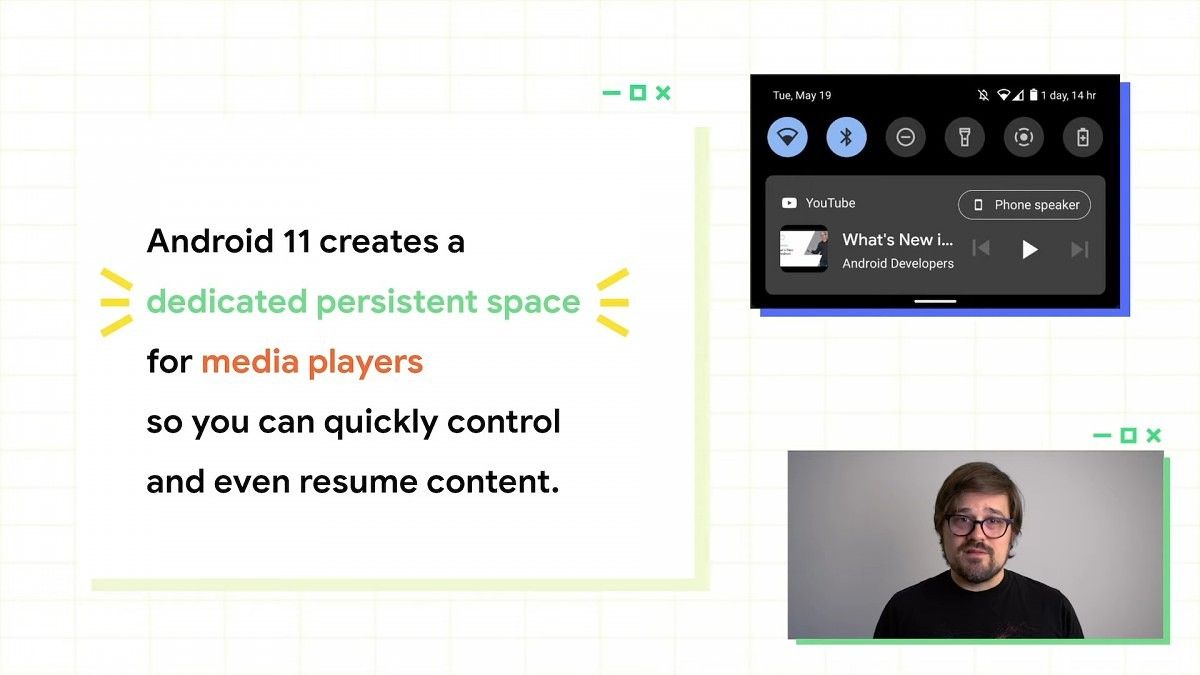
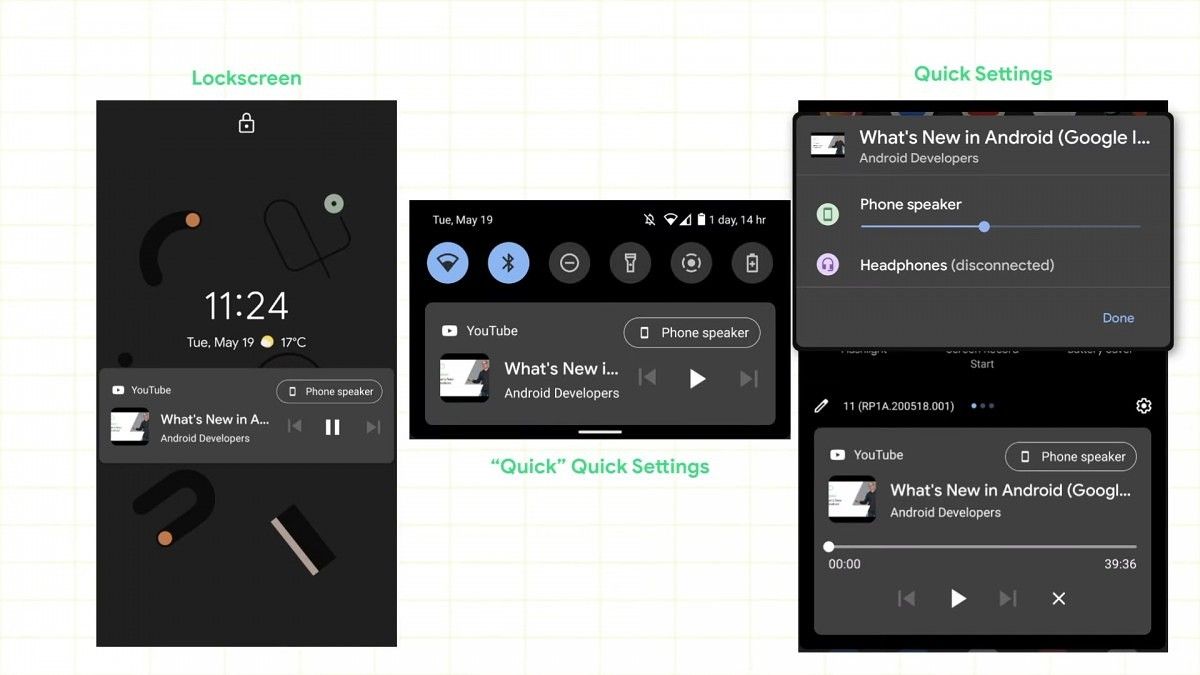
Google is now consolidating media playback notifications by creating a dedicated persistent space for media players in the Quick Settings panel in Android 11. This gives users easy access to media controls regardless of what app is showing or what other notifications are pending. Media controls can also show up on the lock screen, too. What’s more, Google has added a new button in the top right that launches an output picker dialog so users can quickly choose what device they want to play their media on.

Perhaps the best part of the new Media Controls feature is that media playback notifications can now be persistent across media playback sessions or device reboots. If an app implements the MediaBrowserService and MediaSession, then the SystemUI can show up to 5 previous sessions in the Media Controls part of the Quick Settings panel/lock screen.

If multiple media sessions are available, Android 11 will arrange them in a swipeable carousel. The carousel lists media sessions in order from streams playing locally on the phone to remote streams (such as for cast sessions) to previous resumable sessions (in the order in which they were last played).

Android 11 media controls sessions

That means that if you recently ended a media session in Spotify, Pandora, YouTube Music, or other media streaming applications, meaning their media playback notifications are no longer visible, you won’t have to open up those apps again just to resume playback.

In Android 11 Beta 1, this feature is currently not enabled by default. Users will have to go to Settings > Developer Options and then toggle “Media Resumption” for the new Media Controls to show up. Take note that the screenshots that Google shared in their official Android 11 announcement are from a slightly newer build than Beta 1, but the functionality is still there, so Google encourages developers of media applications to play around with this new feature.

For more information on how the new Media Controls work, check out Google’s developer documentation or watch the video below from Dan Sandler on the SystemUI team (time-stamped to 7:30).

The post Android 11’s new Media Controls can remember up to 5 previous media sessions appeared first on xda-developers.


from xda-developers https://ift.tt/2Yowpog
via IFTTT

YouTube Music and Premium are available in 14 new countries

YouTube Music’s revamp and YouTube Premium were kicked off two years ago. YouTube Music was positioned as an eventual replacement for Google Play Music, but that has only started to happen in earnest just recently. YouTube Premium, on the other hand, was a rebrand of “YouTube Red,” the company’s paid ad-free platform. Both services are now rolling out to 14 new countries.

  • American Samoa
  • Aruba
  • Belarus
  • Bermuda
  • Cayman Islands
  • Egypt
  • French Guyana
  • French Polynesia
  • Guadeloupe
  • Guam
  • Northern Mariana Islands
  • Papua New Guinea
  • Puerto Rico
  • U.S. Virgin Islands

Both YouTube Music Premium and YouTube Premium are now available in these new countries, bringing the total number up to 95. Student memberships are now available in Egypt, but family plans have been removed from Belarus. Interested customers can visit the YouTube Music Premium or YouTube Premium pages to subscribe.

YouTube Music has a free tier, but it’s not really useful as a music streaming service to rival Spotify or Google Play Music. You need to pay for Premium in order to listen to music in the background. YouTube Premium removes all ads from videos and gives you the ability to download videos for offline viewing. If you live in one of the newly supported countries, check them out.

YouTube Music - Stream Songs & Music Videos (Free, Google Play) →

YouTube (Free, Google Play) →


Source: Google | Via: Android Police

The post YouTube Music and Premium are available in 14 new countries appeared first on xda-developers.


from xda-developers https://ift.tt/3e3CUnb
via IFTTT

Sony brought the headphone jack back on the Xperia 1 II to give people “a smartphone that they will love”

The Sony Xperia 1 II was announced back in February and became available last month. Despite the odd name (pronounced “mark two”), this is another excellent phone from Sony. It has pretty much all of the specifications that have become standard for flagships in 2020, but one feature, in particular, stands out: the headphone jack.

Headphone jacks are not completely extinct from high-end phones, but it’s a feature that has become increasingly rare. So much so that it’s actually noteworthy that the Sony Xperia 1 II has one. Engadget Japan interviewed four members of Sony Mobile and one of their questions was about the return of the headphone jack. Here is the response from Yuki Ikeda, a member of the System Design Department:

The decision was made to remove the 3.5mm headphone jack on the Xperia XZ2. We made that decision based on the priority we were placing on improving the design of the phone and the fact that wireless earphones were becoming more common.

The reason for bringing the 3.5mm headphone jack back for the Xperia 1 II is from the same mindset we had when developing the Xperia 1, which is to say “giving people a smartphone that they will love.” We also felt it was indispensable for viewing entertainment-related content and for playing games.

That’s a pretty interesting response. Something that a lot of people complain about in regard to removing the headphone jack is the inconvenience. Wireless headphones are great…when they work correctly and are charged. But there are plenty of times when they can overcomplicate a situation that used to be pretty simple. Bringing the headphone jack back ensures that people always have a solution.

Sony Xperia 1 II XDA Forums

Engadget Japan’s interview is quite insightful and there are a number of other things to note. They said that 70-80% of users who purchased the Xperia 1 were satisfied with the display performance, which is why they kept the 21:9 aspect ratio on the Xperia 1 II. The lenses have a special coating on them to “minimize flare and ghosting.” Video recording has a built-in wind noise reduction features.

There are tons of great tidbits from the full interview, which we recommend you read here.

The post Sony brought the headphone jack back on the Xperia 1 II to give people “a smartphone that they will love” appeared first on xda-developers.


from xda-developers https://ift.tt/3cXC2z7
via IFTTT

How to download Android 11 Beta for Google Pixel and other Android devices

Google has officially kicked off the Android 11 Developer Preview program, just five months after the stable release of Android 10. They’re starting things a little earlier this year (the first Android Q beta dropped in March). If you’re curious about the next version of Android, you can download Android 11 right now for the Pixel 2, Pixel 2 XL, Pixel 3, Pixel 3 XL, Pixel 3a, Pixel 3a XL, Pixel 4, and Pixel 4 XL (the original Google Pixel and Pixel XL are not officially supported).

This page will serve as an archive for all the Android 11 developer preview/beta releases. We will keep the page updated with the latest OTAs and factory images for supported devices. You can learn how to install the Android 11 developer preview with our guide for Pixel devices here.


Android 11 Developer Preview 1

GSI Downloads

ARM64+GMS Link
x86+GMS Link

Android 11 Developer Preview 2

GSI Downloads

ARM64+GMS Link
x86+GMS Link

Android 11 Developer Preview 3

GSI Downloads

x86+GMS Link
ARM64+GMS Link
x86_64 Link
ARM64 Link

Android 11 Developer Preview 4

GSI Downloads

x86+GMS Link
ARM64+GMS Link
x86_64 Link
ARM64 Link

Android 11 Beta 1

Android Beta releases have a few extra ways that you can install the updates. The easiest method is to go to google.com/android/beta and enroll your device in the program. You can also use the Android Flash Tool, which will handle many of the flashing steps for you. Below you will find the files for manual flashing.

GSI Downloads

x86+GMS Link
ARM64+GMS Link
x86_64 Link
ARM64 Link

The post How to download Android 11 Beta for Google Pixel and other Android devices appeared first on xda-developers.


from xda-developers https://ift.tt/2HzKjvE
via IFTTT